
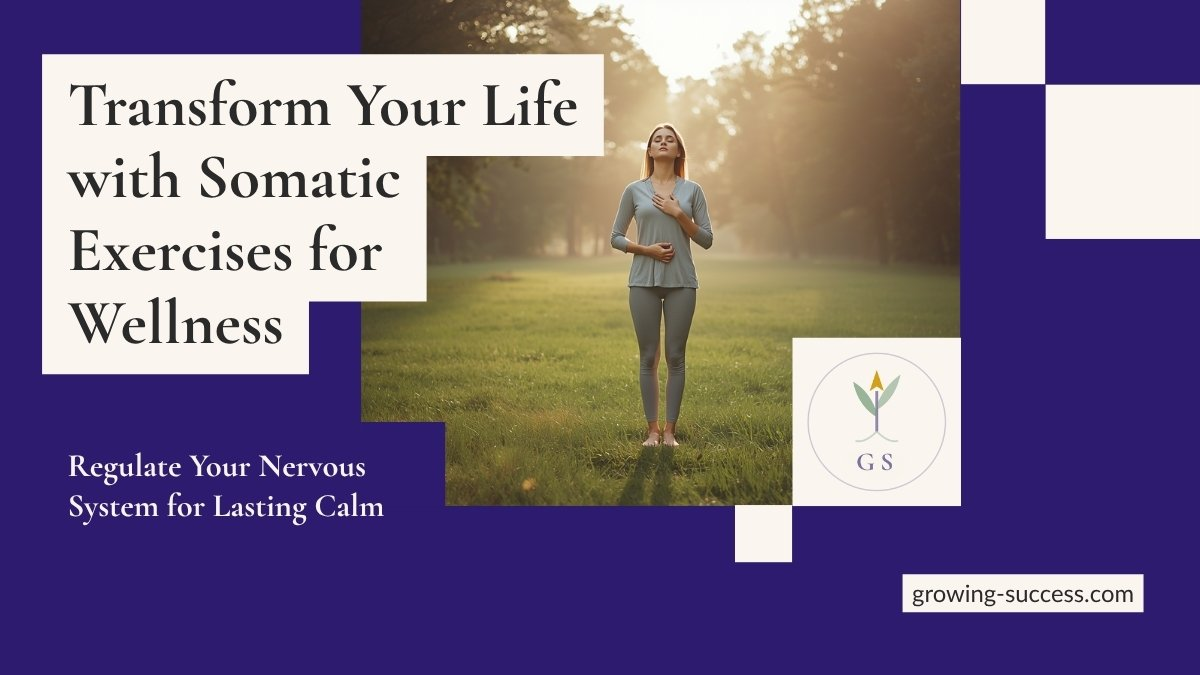
10 Somatic Exercises to Regulate Your Nervous System (5 Minutes or Less)
Somatic exercises are simple, body-based practices — breath, movement, touch, and orientation — that speak directly to your nervous system in its own language: sensation. When your system is stuck in fight-or-flight (racing thoughts, tight chest, snapping at people you love) or in shutdown (numb, foggy, exhausted), thinking your way out rarely works. The body got you into the state; the body is the way back.
This is why somatic work has moved from fringe to forefront — researchers and clinicians now name nervous system regulation as the defining wellness focus of 2026 (Global Wellness Summit). Below are ten exercises you can do anywhere, most in under five minutes, plus the one habit that turns scattered techniques into real rewiring.
How These Work (The 60-Second Science)
Your autonomic nervous system constantly scans for safety or threat. The vagus nerve — the long wandering nerve connecting brain to heart, lungs, and gut — is the main channel of the calming (parasympathetic) branch. Slow exhales, humming, gentle pressure, and orienting the senses all stimulate vagal tone, signaling safe from the body up (Cleveland Clinic explains the vagus nerve). Practiced regularly, these exercises don’t just calm a moment — they widen your baseline capacity to handle stress without tipping over.

The 10 Somatic Exercises
1. Physiological sigh (30 seconds)
Two inhales through the nose — one deep, then a short top-up sip — followed by a long, slow mouth exhale. Repeat three times. The fastest evidence-backed downshift there is.
2. Orienting (1 minute)
Slowly turn your head and let your eyes wander the room, landing on five things. Name them silently. This tells your primal brain: we have looked, and there is no tiger.
3. Self-havening (2 minutes)
Cross your arms and slowly stroke from shoulders to elbows, like calming a child. Soothing touch releases oxytocin — and yes, your own hands count.
4. Voo breathing (2 minutes)
Inhale, then exhale a low, long “voooo” — a foghorn from your belly. The vibration massages the vagus nerve from inside. Developed in Peter Levine’s Somatic Experiencing tradition.
5. Shaking (3 minutes)
Stand and shake — hands, arms, legs, whole body, like an animal after a near-miss. Ridiculous-looking, profoundly effective for discharging stress chemistry. Music helps.
6. Push the wall (2 minutes)
Press your palms into a wall, hard, for 10 seconds; release; repeat five times. Gives mobilized fight-energy somewhere to complete — which is what it’s been waiting for.
7. Cold water on wrists and face (1 minute)
Triggers the dive reflex, slowing heart rate quickly. (Use as a calm-down aid, not as a substitute for feeling what needs feeling. )
8. Weighted exhale counting (3 minutes)
Inhale for 4, exhale for 8, counting on your fingers. Ten rounds. Long exhale = parasympathetic on.
9. Bilateral tapping (2 minutes)
Cross arms over chest, alternate slow taps on each shoulder — the “butterfly hug” used in trauma therapies. Rhythmic left-right stimulation settles the system.
10. Feet on the earth (5 minutes)
Barefoot on grass or floor: press each part of each foot down slowly, noticing texture and temperature. Grounding is literal before it’s metaphorical.

The Habit That Makes Them Stick: Track Your Nervous System
Here’s what separates people who collect techniques from people who actually change their baseline: a record. Your nervous system has patterns — certain triggers, certain times of day, certain exercises that work for your body and not the influencer’s. You only see those patterns when you write them down. After each practice, log three lines:
- Before: activated / shutdown / mixed — and where I felt it in my body
- Practice: what I did, for how long
- After: what shifted (even 10% counts)
Within two weeks you’ll have a personalized regulation map. This pairs naturally with somatic journaling — the exercises settle the body; the writing integrates what the body was holding. And because a regulated nervous system is the foundation under all deeper work — shadow work, trauma recovery, even manifestation — this practice belongs at the start of any healing path. The Shadow Work Workbook offers a structured, prompt-by-prompt path through the inner work, and the whole Heal collection is here for when you are ready to go deeper.

FAQ
How often should I do somatic exercises?
Daily micro-doses beat weekly marathons. Two minutes, two or three times a day, attached to existing habits (kettle boiling, car parked, teeth brushed).
Which exercise should I start with?
The physiological sigh — it works almost universally and takes 30 seconds. Then experiment and track.
Can somatic exercises replace therapy for trauma?
No — they’re regulation tools, not trauma processing. They make excellent companions to trauma-informed therapy, and good preparation for it.
Why do I feel emotional after shaking or voo breathing?
Stored activation often carries emotion with it on the way out. That’s release, not malfunction. Let it move, then ground with orienting.
Go deeper into the inner work: explore the Heal collection →
External sources referenced: Cleveland Clinic — vagus nerve · Somatic Experiencing International ·
Table of Contents
The short version: these somatic exercises work by giving your body direct evidence of safety rather than arguing with it. Below you will find five somatic exercises, the order to run them in, what to do when a practice makes you feel worse, and how to pair somatic exercises with writing.
Why Somatic Work Reaches What Thinking Cannot
You can understand a pattern completely and still repeat it, which is the experience that sends most people towards somatic practice in the first place. Insight lives in one part of the system. The tightening in your chest when someone raises their voice lives somewhere else, and it does not read the notes you took in therapy.
Somatic exercises work from the other direction. Instead of explaining to the body what is safe, they give it direct evidence: slower breath, a longer exhale, a change of position, sustained contact. The body updates on evidence rather than argument, which is why five minutes of the right physical practice can shift a state that an hour of analysis could not.
The Practices, and What Each One Is For
Extending the exhale
Breathe in for a count of four and out for a count of six to eight, for two minutes. A longer exhale than inhale is the simplest lever most people have for shifting towards a calmer state. Do not force the length; if the count makes you tense, shorten both sides and keep the ratio.
Orienting
Slowly turn your head and let your eyes land on five specific things in the room, naming each one silently. This is not a distraction technique. Deliberate visual orientation is how the body checks its environment, and doing it slowly and consciously interrupts a scanning state that has become automatic.
Weight and contact
Sit with both feet flat and press them into the floor for ten seconds, release, and repeat three times. Then notice where your body is supported: chair, floor, backrest. Physical evidence of support is doing something quite different from telling yourself you are supported.
Shaking and completion
Stand and let your hands, then arms, then legs shake loosely for thirty to sixty seconds, then stop and stand still and notice. Many animals discharge activation this way after a threat passes. It looks strange and it is one of the fastest ways to move stuck energy out of a held state.
Slow, small movement
Choose one joint and move it as slowly as you can for one minute, paying complete attention. Slowness is the active ingredient, because it forces the nervous system out of speed and into sensing.
How to Sequence Them
Order matters more than duration. A reliable five-minute sequence: orient first, then extend the exhale, then weight and contact, then finish with slow movement. Orienting first is deliberate, because breathing exercises attempted while the system is still scanning often feel worse rather than better.
If you only have sixty seconds, do orienting alone. It is the practice with the highest return on the least time, and it can be done in a meeting without anyone noticing.
When a Practice Makes You Feel Worse
This happens, particularly with breath work and particularly for people with trauma histories, and it does not mean you did it wrong. Turning attention inward can amplify sensation before it settles. Some useful adjustments:
- Open your eyes. Almost every practice here works with eyes open, and for many people that is the version that works at all.
- Go shorter. Thirty seconds repeated three times a day beats ten minutes that leaves you rattled.
- Choose movement over stillness. Walking, shaking and slow motion are often tolerable when sitting quietly is not.
- Stay oriented outward. Keep some attention on the room rather than taking all of it inside.
- Stop if it escalates. Escalating distress is a signal to work with a trained professional rather than to push through alone.
Pairing Somatic Practice With Writing
The practices change state. Writing is what turns a changed state into knowledge you can use next week. Doing them in that order matters: regulate first, then write, because writing from a flooded state usually produces rumination rather than insight.
- Note the trigger in one line, factually, without interpretation.
- Note where you felt it in your body and what the sensation was actually like: temperature, weight, movement, tightness.
- Note which practice you used and what changed, if anything.
- After four weeks, look for repeats. Most people find that two or three specific sensations account for the majority of their difficult moments.
Frequently Asked Questions About Somatic Exercises
How often should I practise?
Short and daily beats long and occasional. Two minutes, twice a day, at the same times, builds the capacity you want available in a difficult moment. Practising only when distressed teaches the system that the practice belongs to distress.
How long before I notice a difference?
Within a single session you may notice a small state change. The durable shift, where your baseline moves and you recover faster from activation, generally takes weeks of consistency rather than days.
Is this a replacement for therapy?
No. These are self-regulation tools that work well alongside professional support and poorly as a substitute for it, particularly where there is a trauma history. If your symptoms are persistent, escalating, or interfering with daily life, work with a licensed professional trained in somatic or trauma-informed approaches.
Do I need to feel something for it to be working?
Not necessarily. Some people have limited interoceptive awareness at first, and noticing very little is a normal starting point rather than a failure. Awareness itself is one of the things that develops with practice.
Start Tonight
Do the sixty-second version once today: turn your head slowly and name five things you can see. That is the whole first step. Add the exhale tomorrow.
If you want the noticing structured rather than improvised, the guided journals below pair the physical practice with dated pages, so the sensations you record become a pattern you can actually read back. This is a sensitive area; if difficult material surfaces, please involve a qualified professional as well.
Building a Practice You Can Reach in a Crisis
The point of practising when you are calm is that a practice is nearly impossible to learn while distressed. The state you most need it in is the state least capable of acquiring it, which is why the daily two minutes matters so much more than an occasional long session.
- Choose one practice as your default. Not five. One, that you do every day, so that in a difficult moment there is no choosing involved.
- Practise it in the places you are likely to need it. At your desk, in the car, in the corridor outside a difficult room. Context-bound practice is more retrievable.
- Make it invisible. Orienting and extended exhale both work in company without anyone noticing, which matters because most difficult moments are not private.
- Attach it to an existing cue. Every time you wash your hands, every time you sit down at your desk. Repetition against a cue is what makes it automatic.
What Changes Over Six Months
The changes people report from sustained somatic practice are unglamorous and cumulative, and they are easy to miss without a record.
The most commonly described are a shorter recovery time after activation, an earlier warning before an emotion becomes overwhelming, and a widening of what registers as tolerable — being able to sit with a difficult conversation without needing it to resolve immediately. None of these announce themselves. Most people notice them retrospectively, which is the argument for writing one line a day even when nothing seems to be happening.
Doing This in Places You Cannot Be Obvious
Most difficult moments happen in company. In a meeting, at a family table, in a corridor after a hard conversation. A practice that requires lying on the floor is of no use in the moment you most need it, which is why it is worth knowing which of these work invisibly.
- Extended exhale. Entirely undetectable. Breathe out slightly longer than you breathe in, for a minute. Nobody will notice and it is the most powerful lever on the list.
- Orienting. Look slowly at four or five objects, naming them silently. Reads as thinking rather than as a technique.
- Feet into the floor. Press down for ten seconds and release, under a table, three times. Invisible and surprisingly effective.
- Jaw and tongue. Unclench the jaw, let the tongue rest away from the roof of the mouth. A remarkable amount of held tension lives here and releasing it is free.
- One slow hand movement. Turning a pen over deliberately, or moving a cup two inches. Slow deliberate movement interrupts a speeding state without announcing itself.
Practise these specifically in the settings where you will need them, not only at home in a quiet room. State-dependent learning is real enough that a technique rehearsed only on a yoga mat is often unavailable at a desk.
Tracking Whether It Is Actually Working
The changes from somatic practice are cumulative and unglamorous, which makes them easy to dismiss without a record. Three measures are worth keeping, one line each per day.
- Time to settle. After the day’s hardest moment, roughly how long until you felt like yourself. Minutes or hours. This is the single best measure available.
- How early you noticed. Did you catch the activation as it rose, or only afterwards. Early noticing is the skill that develops first.
- What you used and whether it helped. Over a month this becomes a personal shortlist that is more reliable than any general recommendation.
Read the month back in one sitting. What you are looking for is not the absence of hard moments but a shortening of the recovery interval, and that is nearly always visible by week four even when nothing feels different day to day.
A Note on Expectations
These practices are regulation tools, not cures, and setting expectations accordingly is part of using them well. What they reliably do is shorten recovery, widen the gap before a reaction, and give you something to reach for in a difficult moment.
What they do not do is remove the difficulty, resolve its causes, or substitute for treatment where treatment is needed. A practice held to a realistic standard tends to be kept; one expected to fix everything gets abandoned the first time something is hard.
Somatic Exercises: The Sixty-Second Version
If you only ever use one of these somatic exercises, use orienting: turn your head slowly and name five things you can see. Of all the somatic exercises here it has the highest return on the least time and works in company without anyone noticing.