How to Heal from Narcissistic Abuse: A 90-Day Path Back to Yourself
The short version: how to heal from narcissistic abuse begins with logistics and sleep rather than insight, and the first month is for stabilising rather than excavating. Below you will find the first seventy-two hours, why no contact is a practical tool, a ninety-day shape, and when to involve a professional. Anyone asking how to heal from narcissistic abuse deserves a plan rather than a platitude.
How to Heal from Narcissistic Abuse: A 90-Day Path Back to Yourself
You keep waiting to feel like yourself again.
You left — or you’re working up the courage to. You know what happened was not okay. You have read the articles, listened to the podcasts, maybe even said the words out loud: I was in a narcissistic relationship.
And still, something feels stuck.
That is not a character flaw. That is not weakness. That is what narcissistic abuse actually does — it doesn’t just hurt you, it restructures the way you understand reality. The gaslighting, the love bombing, the slow erosion of your identity — these are not things you simply shake off by deciding to move on.
Real healing from narcissistic abuse requires something more intentional than time.
Here is what that path actually looks like — and how to walk it.
Why Healing from Narcissistic Abuse Feels Different from Other Heartbreak
Most relationship grief follows a recognizable arc. You grieve a person, a future, a shared life. It hurts. But eventually you move through it.
Narcissistic abuse grief is different because you are often mourning someone who never truly existed — the person you thought you were with, the relationship you were promised, the version of yourself you were before the slow erosion began. You may feel grief, rage, relief, and a desperate longing for answers all in the same afternoon.
You may also find that you do not trust your own perceptions anymore. That is not an accident. Gaslighting is designed to make you doubt your reality, your memory, and your instincts. Rebuilding that trust in yourself is one of the most essential — and most underestimated — parts of recovery.
The 6 Stages of Narcissistic Abuse Recovery
Recovery is not linear. But it does follow a pattern. Understanding the stages can help you stop wondering if something is wrong with you — and start recognizing exactly where you are in the process.
Stage 1 — Understanding What Happened
Before you can heal from something, you have to be able to name it. This stage is about gaining clarity: recognizing the patterns, naming the tactics, and understanding that what felt like love was actually a cycle of control. It is normal to feel disoriented here. The confusion is part of the abuse, not evidence that you are confused by nature.
Stage 2 — Feeling It All
This is where most survivors try to skip ahead — or get stuck indefinitely. Feeling the grief, the anger, the shame, and the loss of a future that was never real is painful and necessary. This stage is not weakness. It is the foundation of everything that comes after.
Stage 3 — Inner Child Healing
Narcissists rarely choose targets at random. They are drawn to specific wounds — wounds that formed long before you met them. Inner child work is not about blame. It is about understanding the patterns that made you vulnerable so you can change them at the root, not just at the surface.
Stage 4 — Reclaiming Your Identity
Who were you before? What did you like, believe, want, feel — separate from who you became inside that relationship? This stage is about finding her again. And discovering, perhaps with surprise, that she never fully left.
Stage 5 — Boundaries and Self-Trust
Boundaries are not walls. They are the honest expression of what you will and will not accept — and they are built on self-trust. For many survivors, trusting yourself again is the hardest part of recovery. This stage is where that trust is rebuilt, one small decision at a time.
Stage 6 — Building Your New Life
You are not starting over. You are starting from experience, from hard-won wisdom, from a depth of self-knowledge most people never develop. This final stage is about choosing what comes next — deliberately, clearly, and on your own terms.
Why Journaling Works for Narcissistic Abuse Recovery
Journaling is not just a wellness trend. For survivors of narcissistic abuse, structured written reflection serves specific clinical functions:
- It externalizes your thoughts, reducing the mental loop of rumination
- It creates a paper trail of your own reality — a counterweight to months or years of gaslighting
- It allows you to track progress in a way that purely internal healing cannot
- It gives you a private, unjudged space to feel and process at your own pace
The key word is structured. A blank journal can be overwhelming when you are in survival mode. What works is guided prompting — questions that meet you where you are and lead you forward, stage by stage.
A 90-Day Healing System Built for Exactly This
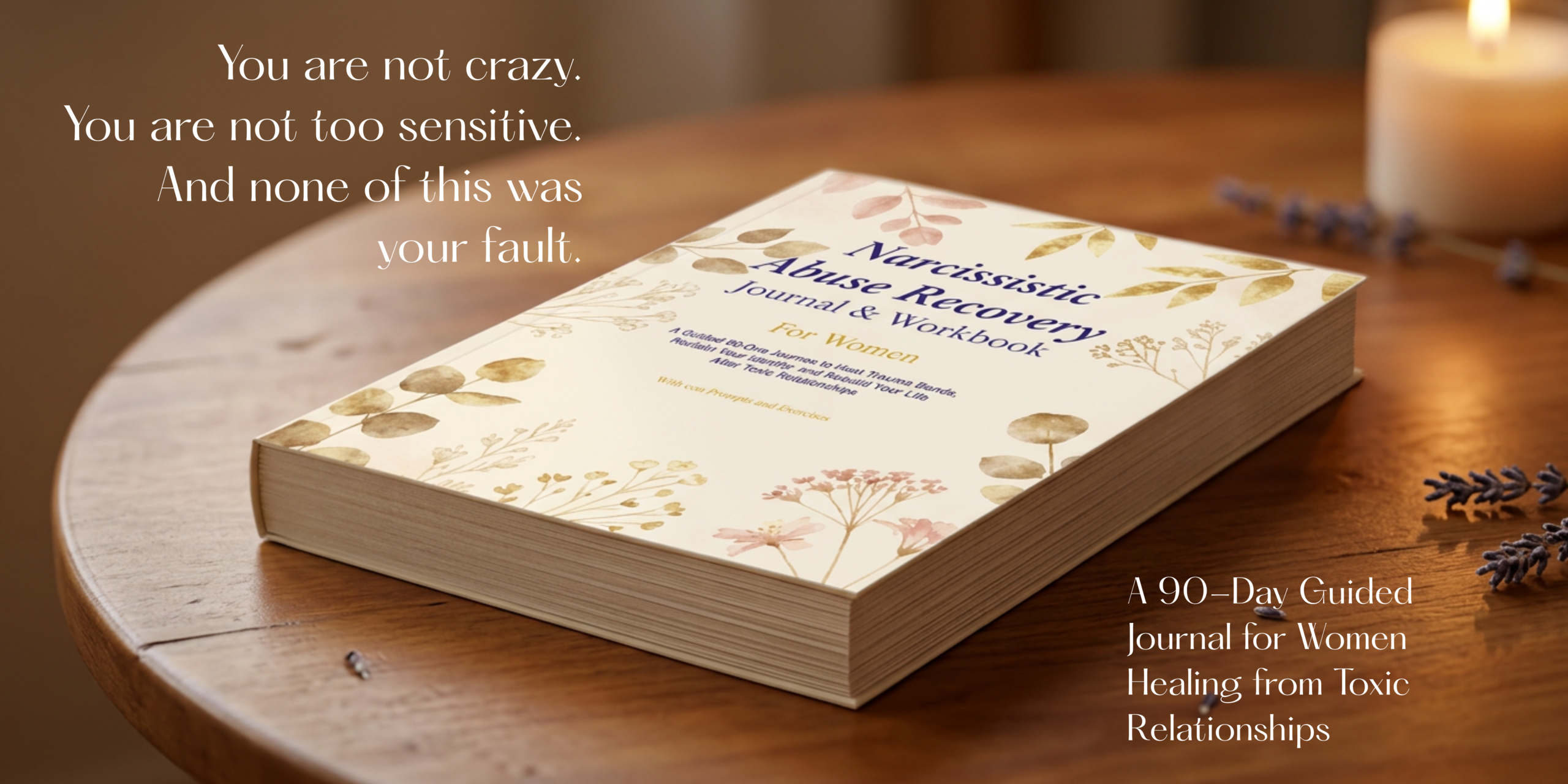
The Narcissistic Abuse Recovery Journal and Workbook for Women was designed specifically for women walking this path. It is not a collection of generic prompts. It is a complete 90-day system that follows the six stages of recovery above — with 100+ prompts, somatic body check-ins, inner child healing exercises, a Moon Cycle Healing Framework, and boundary-building work woven throughout.
What makes it different from other recovery journals is that it treats healing as what it actually is: work that happens in the body and the mind, not just on the page.
Each section opens with a somatic grounding practice. Every prompt invites you to notice where you feel it in your body — because trauma does not live only in your thoughts. The Moon Cycle Framework gives your healing a natural rhythm: new beginnings, growth, release, rest — over and over until the new pattern becomes your baseline.
→ Download the Narcissistic Abuse Recovery Journal — Instant PDF
What Healing Actually Looks Like
It is not a single breakthrough. It is not the day you finally stop crying, or the week you feel like yourself for the first time, or the moment you see him for who he really was.

It is quieter than that. It looks like a morning where you wake up and your first thought is yours — not about him. It looks like saying no and not immediately apologizing. It looks like noticing a red flag and trusting it, instead of explaining it away.
It looks like 90 days of showing up for yourself, one honest page at a time.
You survived something that was designed to make you doubt your own mind. The fact that you are here — reading this, looking for a path forward — is not a small thing.
You are already healing. Let’s make it intentional.
→ Begin Your 90-Day Recovery Journal — Download Instantly
The First Seventy-Two Hours
The days immediately after leaving are not the time for insight. They are the time for logistics and sleep, and treating them as anything more ambitious is how people end up back where they started by the weekend.
- Somewhere to sleep that is yours. Not comfortable, just yours, and not somewhere they can arrive.
- One person who knows where you are. One is enough. Being unaccounted for is its own kind of danger.
- Documents and access. Identification, bank access, medication, keys, anything for children or animals.
- A written record started today. Dates and facts, kept somewhere private. You will not trust your memory in three months, and you will be glad of this.
- Nothing decided that does not have to be. No conversations about the future, no explanations to extended family, no announcements.
If there is any question of physical safety, contact a domestic abuse service in your country before anything else on this list. They deal with exactly this and they will know things you cannot know from inside it.
Why No Contact Is a Practical Tool, Not a Punishment
No contact is often framed as a moral position or a way of winning. It is neither. It is a practical response to a specific mechanism: intermittent reinforcement, which is the most durable conditioning pattern that exists, and which cannot fade while it is still being intermittently reinforced.
Every contact resets the clock. Not because you are weak, but because that is how the conditioning works, in anyone. Understanding it as mechanics rather than as willpower removes an enormous amount of shame from the times you slip.
When no contact is not possible
Shared children, shared property, ongoing legal process. The workable version is contact that is minimal, written, factual and scheduled. No phone calls where you can avoid them, because voice carries tone and tone is the vector. Everything in writing, everything about logistics, nothing about feelings, and a delay before every reply so nothing is sent from a flooded state.
Rebuilding a Day
A life organised around another person’s moods leaves a shape behind when the person goes. What fills it, initially, is nothing, and nothing is unbearable. Structure is the treatment, and it should be boring on purpose.
- Same wake time, seven days. The single highest-value intervention available and the least interesting.
- Three meals, whatever they are. Appetite frequently disappears; eating on schedule rather than on hunger bridges that.
- Twenty minutes outside daily. Not exercise. Daylight and movement.
- One small completed task per day, written down and ticked. Evidence of agency is what erodes fastest and rebuilds fastest.
- A fixed bedtime routine. Sleep is where most of the repair happens and it is the first thing to go.
The Ninety-Day Shape
Ninety days is not a promise of recovery. It is a workable container: long enough for the initial storm to pass and for structure to establish, short enough that you can see the end of it from the beginning.
- Days 1 to 30 — stabilise. Sleep, food, structure, safety, and the written record. No excavation.
- Days 31 to 60 — reality. Read your own record. Name what happened in plain language. Expect the doubt to return and answer it with your own dated notes rather than argument.
- Days 61 to 90 — you. What do you actually like? Start with small, low-stakes preferences and rebuild upward. This is slower and stranger than people expect, and it is the part that lasts.
What to Say to People
You will be asked, repeatedly, and the questions rarely come at a convenient moment. Prepare two sentences in advance and use them without variation: one for acquaintances, one for people you actually trust. Having them ready means you are not composing an explanation in the supermarket with someone watching your face.
You do not owe anyone the full account, including family, including people who were fond of them. The right to your own story includes the right not to tell it.
When to Get Professional Support
Structure and writing carry a great deal, and they are not treatment. Please involve a licensed professional, ideally one experienced in coercive control, if you are experiencing intrusive memories, sustained inability to sleep, panic that interferes with daily function, or any thoughts of harming yourself. This is a genuinely hard topic, and support is a practical tool rather than an admission of anything.
Frequently Asked Questions
Why do I feel worse now than when I was in it?
Because survival states suppress a great deal, and safety is what allows it to surface. Feeling worse after leaving is a common and well-recognised pattern rather than a sign you made the wrong choice.
How do I stop checking on them?
Make it mechanically harder rather than relying on resolve: block, mute, log out, remove the app. Then track the days since you last looked, because a visible number is far more motivating than an intention.
Will I be able to trust anyone again?
Most people do, and it comes back in the order of small things first. Trusting your own read on a room returns before trusting another person does, which is why the perception work matters so much.
Start With One Page
Tonight, write three dated facts. Not feelings, not analysis. Three things that happened, with dates. Then put it away. That page is the foundation for everything in the ninety days that follows.
If you want the ninety days already structured, the recovery journals below take one step per day, with the teaching on the page and no prompt repeated, so you are never staring at a blank sheet on a day you have nothing left. And if any of this is live for you right now, please reach out to a qualified professional or a domestic abuse service as well.
Practical Logistics Nobody Prepares You For
Recovery writing tends to concentrate on the emotional work, and the first months are dominated by administration. Being unprepared for the sheer volume of practical tasks is itself a source of distress, so it is worth naming.
- Financial separation. Joint accounts, shared subscriptions, shared bills, anything with saved payment details. Take an inventory before you need it rather than discovering items one at a time.
- Digital access. Shared passwords, family accounts, location sharing, cloud photo libraries, smart-home devices and anything that reports activity. This category is routinely overlooked and is frequently how contact continues.
- Documents. Identification, tenancy or mortgage papers, insurance, medical records, anything for children or animals. Keep copies somewhere only you can reach.
- Addresses. Post redirection, delivery accounts, anywhere your location is on file and shared.
- Formal notifications. Employer where relevant, school, doctor. Not explanations. Facts.
Do these in small batches with a written list, and tick them off. The ticking matters more than it sounds: agency is what erodes most in this kind of relationship, and a visible list of completed tasks rebuilds it faster than almost anything else available in the first month.
If You Have to Keep Contact
Shared children, shared property or an ongoing legal process mean no contact is not available. What is available is contact that is structured so tightly that it carries as little as possible.
- Written only, where you can. Voice carries tone, and tone is the mechanism. Text and email create a record and remove it.
- Logistics only. Times, dates, arrangements. No feelings, no history, no responses to provocation.
- Delay every reply. A fixed rule — never inside an hour — keeps you from sending anything from a flooded state.
- One channel. Agree a single method and do not answer on others.
- Keep everything. Every message, in order, saved somewhere safe. If a legal process is involved this may matter a great deal, and reconstructing it later is not possible.
What the Second Year Looks Like
Almost nothing is written about the second year, and people arriving in it are often unsettled by how ordinary it feels. The acute phase has passed, the structure is holding, and the work has changed shape rather than finished.
What the second year tends to involve: noticing the patterns that predated this relationship and made it possible, deciding what you actually want rather than what you are avoiding, and the specific difficulty of trusting a new person who has done nothing wrong. That last one is slow and it is not a sign the recovery failed. It is the last part, and it moves.
If any of this is live for you right now, please involve a licensed professional or a domestic abuse service alongside anything you write. A journal is a good companion to that work and not a substitute for it.
How to Heal From Narcissistic Abuse: The First Page
How to heal from narcissistic abuse, reduced to one instruction: write three dated facts tonight, in plain language, and put them somewhere private. That page is what your doubting mind will need in three months, and it is the foundation of everything else on this list.