New Moon Intention Setting: A Complete Ritual for the Cancer New Moon (July 14, 2026)
Table of Contents
Why Intention Setting Works (Beyond the Mystical)
Be skeptical if you like — the practice holds up anyway. Writing goals dramatically increases the likelihood of reaching them (Dr. Gail Matthews’ research at Dominican University found written goals significantly outperform unwritten ones). A recurring monthly ritual adds two more advantages: rhythm — you review and re-aim twelve times a year instead of one abandoned January — and reflection, because each new moon asks you to check what actually grew last cycle. The moon is, among other things, the best accountability calendar ever hung in the sky.
New Moon Intention Setting Ritual (30 Minutes)
1. Clear the space (5 minutes)
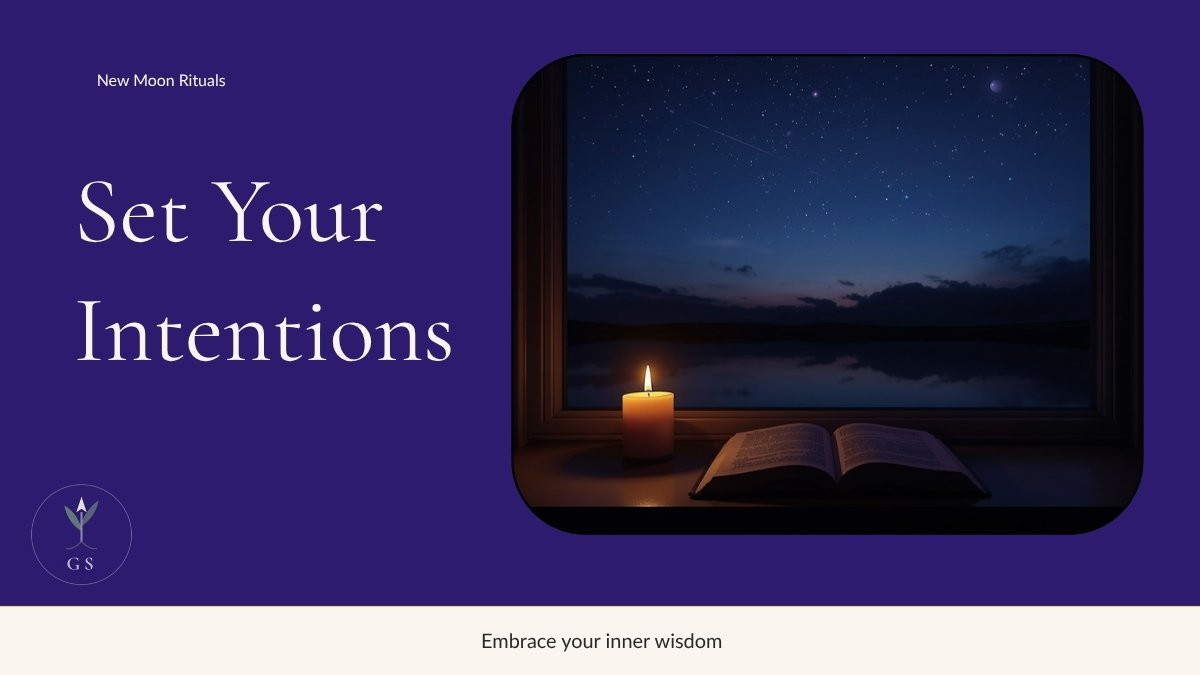
The new moon favors emptiness. Tidy one small corner, light a candle, silence the phone. If it’s warm enough, sit outside in the dark — July nights were made for this. Take ten slow breaths and arrive.2. Review the last cycle (5 minutes)
Open your journal and look back at last month’s intentions (this is where keeping a moon journal pays its rent). Write briefly:- What did I plant last cycle that sprouted?
- What didn’t — and what is that teaching me?
- What am I still tending that needs more time?
3. Set 1–3 intentions (10 minutes)
Less is more. Phrase each one in present tense, beginning from feeling rather than acquisition. Under this Cancer moon especially, try these frames:- “I am creating a home that feels like ______.”
- “I nurture ______ in myself daily.”
- “I allow myself to need ______ and to receive it.”
4. Seal and release (5 minutes)
Read your intentions aloud. Close the journal, blow out the candle, and stop gripping. Seeds don’t grow because you dig them up nightly to check. Revisit at the full moon — the Buck Moon on July 29 — to see what’s risen.
10 Cancer New Moon Journal Prompts
- Where in my life do I feel most at home? Least?
- What does emotional safety feel like — and who or what provides it?
- What am I nurturing right now? Is it nurturing me back?
- What did “home” teach me growing up, and what am I rewriting?
- What would I create this month if I trusted I belonged?
- What is my intuition whispering that my schedule keeps interrupting?
- What needs of mine have I been treating as optional?
- Who is my chosen family — and how do I want to show up for them this cycle?
- What does my body need more of before summer ends?
- If this lunar cycle had a single word, what do I want it to be?

Build the Practice, Not Just the Night
One new moon ritual will center you. Twelve will change your year. If you want the rhythm without reinventing it monthly, start here:- Free: the New Moon Ritual Guide — join the circle and it arrives in your inbox so you can start now. Trust yourself and let inspiration be your guide.
- The full practice: the Mother Moon Journal gives every phase of every cycle a place to land — intention, tending, harvest, rest — so your moon work becomes a continuous conversation rather than scattered nights. Explore it and the rest of the Root collection.
FAQ
Do I have to set intentions exactly on July 14? The new moon window runs about 48 hours after the exact moment. July 14–16 all carry the energy. How is this different from goal setting? Goals name outcomes; intentions name directions and ways of being. The strongest practice writes both: the intention (how I want to live) and one action (what I’ll do). What if last month’s intentions completely failed? Then you learned what the soil rejects — that’s data, not defeat. Compost it into this month’s planting. The moon doesn’t keep score; it just keeps returning.Get your free New Moon Ritual Guide: join the circle → External sources referenced: CHANI — 2026 new & full moons · Dominican University — written goals study
Why Most New Moon Intentions Never Survive the Month
New moon intention setting fails for a structural reason rather than a spiritual one. People write a wish, feel the lift that writing it produces, and mistake the lift for progress. Two weeks later the page is closed, the intention is unmeasurable, and the only honest verdict is that nothing happened.
An intention that survives has three properties the wish version lacks: it is observable, it is scoped to one lunar cycle, and it names a behaviour rather than an outcome. “Abundance” fails all three. “I open the accounts spreadsheet every Sunday morning before anything else” passes all three, and it is far less romantic, which is exactly why it works.
Intention Versus Goal Versus Wish
A wish
Describes a state you want to arrive in, with no mechanism. Wishes are useful precisely once, as raw material, because they tell you the direction. Left as wishes they generate a monthly cycle of hope and quiet disappointment.
A goal
Describes an outcome with a deadline. Goals are excellent for things entirely inside your control and corrosive for things that are not, because missing one reads as personal failure even when the variable was never yours.
An intention
Describes how you intend to move, not what you intend to obtain. It is the only one of the three that you can honour on a bad day, and honouring it on bad days is the whole mechanism.
How to Write an Intention That Holds
- One cycle, one intention. Twenty-nine days is a genuinely short container. Two intentions halve your attention and quadruple the chance you drop both.
- Name the behaviour, not the result. You cannot control whether the client says yes. You can control that you send three proposals before the full moon.
- Make it observable by a stranger. If someone following you for a week could not tell whether you kept it, it is not specific enough yet.
- Make it smaller than you think it should be. The correct size is one you would still do on your worst day of the month, because that is the day that decides whether it holds.
- Attach it to something that already happens. After the kettle boils. Before the school run. Anchoring to an existing habit does more for follow-through than any amount of motivation.
The Cycle as a Working Structure
The lunar month is useful for intention work not because of any claimed influence on human behaviour, but because it is a container with a clear beginning, a natural midpoint and a fixed end. Twenty-nine days is long enough to establish a rhythm and short enough that you have not forgotten what you meant.
- New moon. Write the single intention, the anchor, and how you will know at the end. Ten minutes.
- First week. Do not evaluate. Evaluation this early is almost always a way to quit with dignity.
- First quarter. One line: is this too big, too vague, or fine? Adjust the size, never the direction.
- Full moon. Review honestly at the midpoint. What has actually happened, in facts. This is assessment, not judgment.
- Waning weeks. Protect the intention rather than adding to it. This is where most people bury a working practice under three new ones.
- Dark moon. Close the cycle. Write what happened, what you learned about your own capacity, and whether it carries into the next round.
What to Do When You Break the Chain
You will miss days. The people whose practices last are not the ones who never miss; they are the ones who have a rule for missing decided in advance. Write yours on the same page as the intention, before you need it.
A good default: never miss twice. One missed day is an event. Two is the beginning of a new pattern, and the second day is where the whole thing is actually won or lost. Notice that this rule requires no self-criticism at all, which is why it survives contact with a difficult week.
Tracking Without Turning It Into Another Job
The record needs to be short enough that you keep it on the day you least want to. One line a day is the correct size. Date, kept or not, and one word about the day. Nothing else.
After three cycles, read the three pages together. Most people find something they could not have predicted: a particular week where the practice reliably collapses, or an anchor that works far better than the one they assumed would.
Frequently Asked Questions About New Moon Intention Setting
Does it have to be exactly on the new moon?
No. The value is the container, not the instant. Any evening within a day or two on either side gives you the same twenty-nine day structure.
Can I set an intention about something outside my control?
Set it about your behaviour towards that thing. You cannot intend that someone forgives you. You can intend that you write the letter, and that is the part that was ever yours.
What if I forget the intention halfway through the month?
Then the anchor was wrong, not your character. Forgetting is nearly always a design failure: no cue, or a cue that does not reliably occur. Rewrite it attached to something that happens every single day without your help.
How is this different from a manifestation practice?
Manifestation work is usually oriented around a desired outcome and the internal state that matches it. Intention setting as described here is oriented around observable behaviour inside a fixed window. They can sit together well, but they are answering different questions.
Your First Cycle
At the next new moon, write one sentence: the behaviour, the anchor, and the observable test. Then write your rule for missing a day underneath it. That is the entire setup, and it takes less than ten minutes.
If you would rather not build the tracking structure yourself, the lunar journals below already have the dated pages, the midpoint review and the closing page for every cycle of the year.
Carrying an Intention Across Several Cycles
Some things are genuinely larger than one lunar month, and the mistake is either cramming them into a single cycle or abandoning the cycle structure entirely. The workable approach is to keep the container and change what sits inside it.
- Name the year-scale thing once, and write it somewhere separate from the monthly page.
- Each new moon, ask what this cycle’s contribution is. One month’s worth, in behaviour terms, with an anchor and a test.
- Do not repeat the same intention three cycles running. If you need to, the intention is either too large or is not actually being worked on.
- Review the year-scale item quarterly, not monthly. Looking at slow things too often makes them look stalled when they are simply slow.
Run this way, twelve cycles produce twelve dated, observable contributions to one larger thing, and a written record of exactly how much progress a year of consistent small effort actually buys. Most people substantially underestimate that number until they have seen it once.
When an Intention Stops Being Yours
Sometimes an intention held for several cycles quietly stops belonging to you, and the tell is that keeping it starts to feel like obedience rather than choice. This is worth catching, because a stale intention will absorb effort indefinitely without ever producing satisfaction.
At each full moon, ask one additional question: if I were choosing this today, from scratch, would I? A no is not a failure. It is the practice doing exactly what a monthly review is for, and releasing it deliberately is a far better outcome than dragging it through another six cycles out of consistency.
One Intention, Twelve Different Cycles
The most instructive thing you can do with this practice is keep the same intention for a whole year and change nothing but the container. Same behaviour, same test, twelve separate cycles, each one closed and reopened.
What that reveals is not whether you can do the thing — you learn that in month one. It is the shape of your own year. Nearly everyone finds two or three cycles where the practice reliably collapses, and the reason is almost never lack of will. It is a season, a recurring work pattern, a school holiday, a stretch of poor light.
Once those months are identified, you can plan for them rather than fail at them: the minimum version in advance, and no new commitments taken on in those weeks. That single adjustment, based on your own twelve months of data rather than on general advice, tends to do more for consistency than any technique.
Intentions That Involve Other People
Half of what people want to set intentions about depends on someone else — a relationship, a promotion, a reconciliation. Written as outcomes these fail, because the outcome was never yours to deliver.
The fix is to write the intention about your side of it, entirely. Not “we communicate better” but “I say the difficult thing within a day of noticing it.” Not “she calls more” but “I make the call I am waiting for twice this month.” Both are observable, both are yours, and both change the situation in the only way you actually have access to.
This is not a lowering of ambition. In practice it is the more demanding version, because it removes the comfortable position of waiting for the other person to move first.
Starting Mid-Cycle
If you read this halfway through a lunar cycle, do not wait for the new moon. Waiting for a clean start is one of the most reliable ways to never begin.
Set the intention today with a shortened container running to the next new moon, and treat it as a trial run. You will learn the mechanics on a low-stakes short cycle and be ready to run a full one properly when it arrives.