
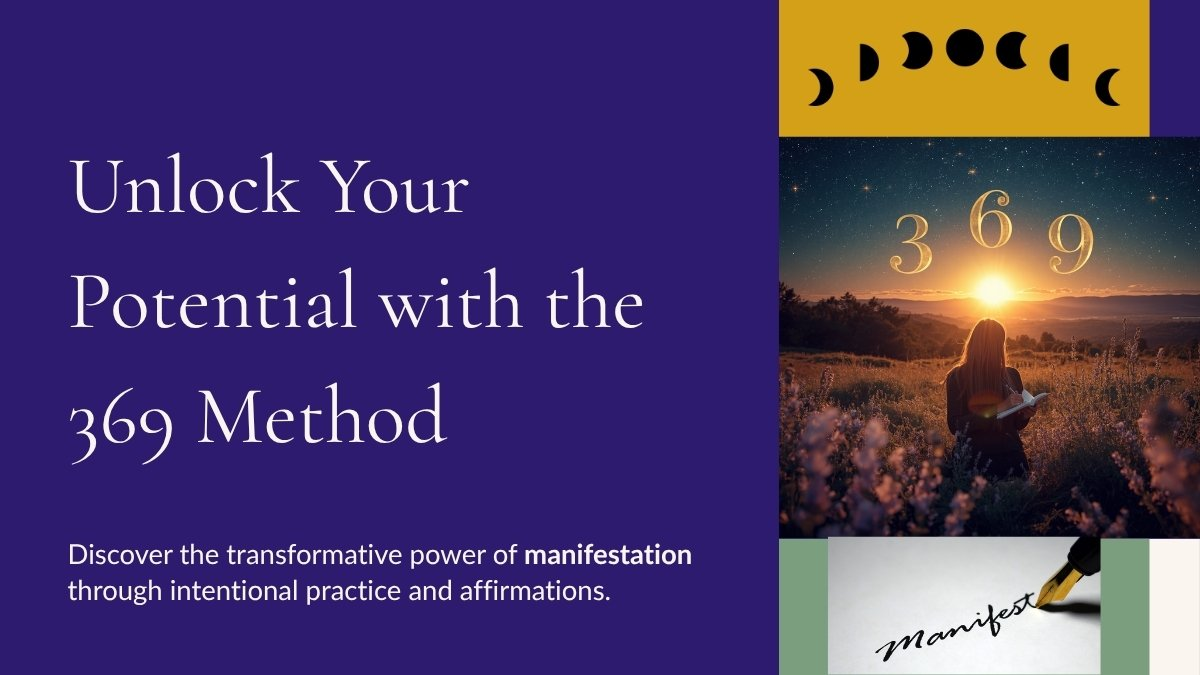
Why the 369 Method Works: The Psychology of Manifestation Journaling
Table of Contents
Want the step-by-step how-to first? Read The 369 Manifestation Method: A Complete Guide for the exact morning, midday, and evening practice, or our broader guide on how to manifest anything. This guide answers the question those don’t: why does writing it down actually work?
Understanding why the 369 method works starts with a simple reframe. The 369 method gets dismissed as either pure magic or pure nonsense, and both takes miss what is really happening. You do not write your intention three, six, and nine times because the universe is counting. You do it because structured, repetitive, emotionally charged writing changes your brain and your behavior in measurable ways. Once you understand the mechanism, the practice stops feeling like a gamble and starts feeling like a tool you can use on purpose.
Your Brain’s Filter: The Reticular Activating System
At the base of your brain sits the reticular activating system, a filter that decides which slice of the overwhelming world reaches your conscious attention. It is why, after you decide you want a certain car, you suddenly see it everywhere. When you write your intention repeatedly, you are programming that filter. You begin noticing opportunities, people, and resources that were always there but invisible to you. Manifestation, in this sense, is selective attention turned deliberate.
Why Writing Beats Thinking
Decades of expressive writing research show that putting experiences and desires into words improves emotional regulation, reduces stress, and even strengthens follow-through on goals. Writing forces vague wanting into specific language, and specificity is what your mind can actually act on. A thought loops; a written sentence commits. The 369 cadence simply builds that translation from fog to clarity into a daily habit, three times a day, until it becomes automatic.

Repetition, Priming, and Emotional Encoding
Repetition consolidates memory and primes behavior. Each time you write your intention, you rehearse the identity of the person who already has it, which quietly shifts the small decisions you make all day. But repetition alone is hollow. The research is clear that emotion is the encoder. Writing on autopilot does little; writing from the felt sense of already receiving is what makes the practice stick. This is the piece most 369 tutorials skip, and it is the difference between a chore and a change.
So Why 3, 6, and 9?
The numbers trace back to Nikola Tesla’s fascination with 3, 6, and 9, and that story is genuinely inspiring, but it is not a law of physics. What the cadence does well is anchor the practice to three natural points in your day, creating morning intention, midday reinforcement, and evening encoding right before sleep, when the brain is most receptive. The structure is the gift, not the numerology. Knowing that frees you from anxiety if you miss a session, and it lets you adapt the rhythm to a life that does not always cooperate.
The Missing Half: Aligned Action
Here is the part the viral videos leave out. Attention without action is a vision board that never ships. The reticular activating system shows you the open door; you still have to walk through it. The most powerful way to use 369 is to pair each session with one small aligned action that moves you toward what you wrote. This is the difference between waiting for magic and partnering with it, and it is the heart of our whole approach to manifestation: dream in ink, then move your feet.
Why the 369 Method Works: The Neuroscience in Plain English
Three systems do the heavy lifting. Your reticular activating system decides what you notice. Your prefrontal cortex turns vague wishes into concrete plans when you write them specifically. And your limbic system tags emotionally charged writing as important, which is why feeling the outcome as you write encodes it far more deeply than rote copying. None of this requires belief in magic. It requires participation. You are not bending reality with a pen. You are retraining the brain that decides which version of reality you are able to see and act on.
A Realistic Timeline
The classic cadence runs 33 to 45 days, and that length is not arbitrary. Behavior change and attentional retraining take weeks, not hours. Expect the first week to feel mechanical, the second to surface doubt, and somewhere in the third or fourth week to notice the first real-world nudges: an unexpected conversation, an opportunity you would have walked past, a sudden willingness to do the thing you had been avoiding. Those nudges are your filter doing its job, and your cue to act on them quickly rather than analyze them to death.
Real Alignment vs. Wishful Thinking
Wishful thinking writes from lack and waits. Alignment writes from receiving and moves. The honest test each day is one question: did I take a single action consistent with what I wrote? If the answer is repeatedly no, the practice is not broken, it is incomplete. Pair the writing with the smallest possible aligned step and the method stops feeling like superstition and starts behaving like strategy. Lack says please; alignment says thank you, and then gets to work.
369 Affirmation Examples That Actually Work
Write in the present tense, from receiving, with feeling. Instead of I want more money, write I am so grateful money now flows to me easily and often. Instead of I hope I find love, write I am so thankful to be loved exactly as I am. Instead of I want my business to grow, write I love watching the right clients find me with ease. The grammar is not superstition. Present tense and gratitude are simply what convince your nervous system the thing is already real, which is what shifts your behavior to match.
When It Feels Like It’s Not Working
Resistance, doubt, and impatience are not signs of failure; they are predictable stages. When the practice feels flat, it usually means you have slipped into mechanical repetition or you are scripting from lack rather than from receiving. Return to the emotion, get more specific, and check whether you have taken any real-world action this week. A guided structure keeps you honest, which is why our 369 manifestation journal pairs the daily cadence with emotional anchoring and aligned-action prompts, so you are not just writing, you are moving. Not sure which journal fits your goal? Take our quick find your journal quiz.
The 369 method works when you treat it as psychology with a soul, not superstition. Understand the mechanism, bring the feeling, take the step, and the practice does exactly what it promises.
What 33 Days Actually Looks Like, Week by Week
Week one is the honeymoon. The novelty carries you, the writing feels exciting, and you are sure this time is different. Week two is where most people quit, because the novelty fades and nothing visible has changed yet. This is exactly when the attentional retraining is happening beneath the surface, so the instruction is simple: keep writing, and keep feeling. Week three is when the nudges usually begin, the small coincidences and openings that are easy to dismiss if you are not paying attention. Week four and beyond is integration, where the practice stops being something you do and becomes the way you naturally orient your attention. If you treat the boring middle as proof the method is broken, you will miss the part where it finally works.
Common 369 Mistakes to Avoid
The first mistake is writing from desperation. When every entry secretly means I do not have this and I am afraid I never will, you are reinforcing lack, not abundance. Shift to gratitude as if it is already done. The second mistake is going through the motions without emotion, which trains repetition but skips the encoder that makes it stick. The third is treating the writing as the whole job. Manifestation is attention plus action, and skipping the action half is why so many people decide it does not work. The fourth is impatience, abandoning the practice on day nine because the universe did not deliver on day eight. Give it the full cycle, bring real feeling, take aligned steps, and you remove almost every reason the method fails.
Does the 369 Method Have to Be Exactly Three, Six, and Nine?
No, and understanding why is freeing. The specific counts give the practice a memorable shape and three reliable anchor points, but the active ingredients are clarity, repetition, emotion, and action, not the numbers themselves. People succeed with 55×5, with simple morning and evening scripting, and with a single deeply felt paragraph a day. If the 369 structure helps you stay consistent, keep it. If it ever becomes a source of anxiety or rigid counting, loosen it. What you never want to drop is the feeling and the follow-through, because those are the parts actually doing the work. The method is a container for a practice, not a magic spell that breaks if you miscount. Hold it lightly, show up daily, and let the psychology do exactly what it is designed to do.
Download our free beginner’s guide from the Free Resources library and start with intention and aligned action.
What Repetition Is Actually Doing
The 369 method asks you to write the same statement eighteen times a day for twenty-one days. It is worth being honest about why that might change anything, because the usual explanations range from vague to overstated, and a practice you understand is one you are far more likely to finish.
The most defensible account is unglamorous: spaced, effortful repetition of a specific phrase keeps a particular goal at the front of your attention across weeks, and what you attend to shapes what you notice and what you choose. That is not mystical and it is not nothing. Most goals fail not because they were impossible but because they stopped being present.
Spacing, and Why the Three Sessions Matter
Writing eighteen lines in one sitting takes the same amount of time and does something different. Spacing the repetitions across morning, midday and evening means the statement re-enters your attention three times in a day rather than once, and the return is what maintains presence between sessions.
It also means the statement meets you in three different states. The version of you at seven in the morning and the version at ten at night are not the same, and a statement that only ever meets one of them is easy to keep at arm’s length.
Why Handwriting, Specifically
Handwriting is slower than typing, and for this practice the slowness is doing the work. Slow production forces you to be present for each repetition rather than producing them mechanically. Many people report that the ninth line of the evening set feels quite different from the first, and that difference is the practice working.
It is worth saying plainly that this is a practical argument rather than a proven mechanism. If handwriting is genuinely a barrier for you, typing the practice is far better than not doing it.
The Honest Version of the Tesla Story
Nikola Tesla is widely quoted as saying that if you knew the magnificence of three, six and nine you would have a key to the universe. The quote is very hard to source reliably, and it appears in popular writing far more often than in anything verifiable from Tesla himself.
This does not undermine the practice. The structure of three, six and nine works as a schedule regardless of its provenance: an escalating daily rhythm weighted towards evening, with a total that is substantial enough to require commitment. Treat the story as an origin myth, which most useful practices have, and judge the method on whether it changes your behaviour.
Why It Fails, Mechanically
When the method does not work, the reasons are usually structural rather than energetic.
- The statement was written from wanting. Eighteen repetitions of longing reinforces the ache rather than the outcome. This is the single most common failure.
- No behaviour attached. Attention without action produces a very clear picture of a life you are not living.
- The statement kept changing. Repetition requires something stable to repeat.
- The sessions collapsed into one. Which removes the spacing, which was most of the mechanism.
- It was measured by feeling. Feelings on day eleven are a report on day eleven, not a verdict on the practice.
What to Measure Instead
If you want to know whether it is working, track two things and ignore everything else.
- Behaviour. Did you do something this week that the person in your statement would do? Yes or no, weekly.
- Noticing. Did you spot an opportunity, a resource or a connection relevant to the statement that you would probably have walked past a month ago?
Those two questions are answerable honestly, and together they capture almost everything the method plausibly does.
Frequently Asked Questions About Why the 369 Method Works
Is there scientific evidence for the 369 method specifically?
No, not for the specific numbers or the specific structure. The components it draws on — repetition, attention, written goals and consistency — are more widely discussed, but the method as a package should be treated as a practice rather than an evidence-based intervention.
Does the number of repetitions matter?
What matters practically is enough repetition to sustain attention and a structure you will actually complete. Three, six and nine give you that in a memorable form, which is a real advantage over an arbitrary number.
Why twenty-one days?
It is long enough to establish a rhythm and short enough to see the end from the beginning. The commonly repeated claim that habits form in twenty-one days is not well supported, so treat the length as a workable container rather than a threshold.
Can I do it for something I do not fully believe is possible?
Move the statement closer until you can write it without internal argument. A statement you privately reject produces twenty-one days of quiet contradiction, which is worse than not starting.
Try It With Something Small
Rather than beginning with the largest thing you want, run one cycle on something modest and specific. Twenty-one days on a small statement teaches you how the practice behaves in your hands, and that knowledge transfers.
The 3-6-9 journal below carries the twenty-one days in dated form, with the affirmation formula that keeps the statement out of wanting, and the shadow pages for the resistance that arrives predictably around day nine.
What a Fair Test Would Look Like
If you wanted to know whether this works for you rather than in general, the test is straightforward and almost nobody runs it. Choose two comparable wants of similar difficulty. Run a full twenty-one day cycle on one and do nothing structured on the other. Record behaviour and evidence weekly for both, and compare at day twenty-one.
What you are actually measuring is not whether the universe responded. It is whether the practice changed what you did and what you noticed, which is the mechanism anyone can defend. Most people who run this find the difference is real and smaller than the promotional version of the method implies — which is the useful, durable finding rather than the disappointing one.
Keep the comparison honest. Choose the second want before you begin, not afterwards, and do not quietly work on it as well. The discipline of leaving something alone for three weeks is the hardest part of the experiment and the part that makes the answer worth anything.