

50 Shadow Work Journal Prompts for Deep Healing
Table of Contents
Shadow work journal prompts are questions designed to surface the parts of yourself you’ve learned to hide — the anger you swallow, the envy you deny, the needs you’ve decided are “too much.” Psychiatrist Carl Jung called this hidden material the shadow, and he was clear about the stakes: what we refuse to face doesn’t disappear. It directs our lives from below. (The Society of Analytical Psychology offers a good primer on Jung’s shadow concept.)
These 50 prompts are organized in the order real shadow work tends to unfold: triggers first, then origins, then the tender places, then integration. Before you begin, one truth worth naming — this work asks more of you than positivity ever will. You’ll meet things you’d rather not see. That’s not a sign you’re doing it wrong. It’s the doorway.
How to Use These Shadow Work Journal Prompts
- One prompt per session. Depth beats volume. Fifteen honest minutes on one question outworks an hour of skimming ten.
- Write past the first answer. Your first response is usually the rehearsed one. Ask “and what’s under that?” at least twice.
- Ground before and after. A few slow breaths, feet on the floor. If a prompt floods you, stop, breathe, and return another day — or pair this practice with somatic journaling to process what comes up through the body.
- Close kindly. End every session with one line of compassion toward yourself. Shadow before breakthrough — but always breakthrough.
Part 1 — Meeting Your Triggers (Prompts 1–12)
- Who irritated me most this week — and what exactly did they do?
- What trait in others do I judge most harshly? Where does that trait live in me?
- When did I last overreact? What older wound did that moment touch?
- What feedback hurts most to receive? Why that one?
- What kind of person do I secretly envy — and what do they have permission for that I don’t?
- What compliment do I have the hardest time accepting?
- When do I feel the urge to prove myself? To whom?
- What emotion am I most uncomfortable witnessing in others?
- What’s a recurring conflict in my life? What’s my unexamined part in it?
- When someone sets a boundary with me, what do I feel first?
- What am I defensive about — even when no one is attacking?
- What does my inner critic say, word for word? Whose voice is it?
Part 2 — Tracing the Origins (Prompts 13–25)
- What emotions were unwelcome in my childhood home?
- What did I have to do to earn love or approval growing up?
- What part of myself did I first learn to hide — and how old was I?
- What was I praised for as a child? What did that teach me to perform?
- What did I learn about anger? About crying? About needing things?
- Who was I before I learned to be acceptable?
- What family pattern am I repeating that I swore I never would?
- What secret did my family keep — and what did the keeping teach me?
- What did I believe about myself at age ten that I still believe now?
- When did I learn it wasn’t safe to be fully seen?
- What role did I play in my family — peacemaker, achiever, invisible one? Do I still play it?
- What dream did I abandon, and who told me to?
- What would my younger self be surprised — or saddened — to see about my life now?
Part 3 — The Tender Places (Prompts 26–38)
- What am I most afraid people would discover about me?
- Where in my life am I pretending to be fine?
- What do I do when I feel rejected — and what does it cost me?
- What part of me feels unlovable? When did it start feeling that way?
- What needs do I dismiss as “too needy”?
- What’s the lie I tell most often? What does it protect?
- Where am I abandoning myself to keep someone else comfortable?
- What grief have I never given myself permission to feel?
- What am I ashamed of that I’ve never said aloud?
- If my resentment could write a letter, who would it address — and what would it say?
- What do I use to numb — scrolling, busyness, food, achievement — and what am I numbing?
- What truth about my life am I avoiding because it would demand change?
- What part of me is exhausted from performing?
Part 4 — Integration & Reclamation (Prompts 39–50)
- What hidden part of me, if welcomed, would make me more whole?
- What “negative” trait of mine is actually a strength with no healthy outlet?
- What would I do differently if I stopped seeking approval entirely?
- What boundaries would my truest self set this week?
- What is my shadow trying to protect me from? Can I thank it?
- What would it mean to forgive myself for ______?
- What golden shadow do I carry — gifts I’ve projected onto people I admire?
- Where can I offer my unmet childhood need to myself now, concretely?
- What am I ready to stop hiding?
- Who would I be without the story that I’m not enough?
- What’s one act of self-loyalty I can commit to this month?
- Write a welcome letter to the part of yourself you’ve exiled the longest.

Why Structure Matters in Shadow Work Journal Prompts
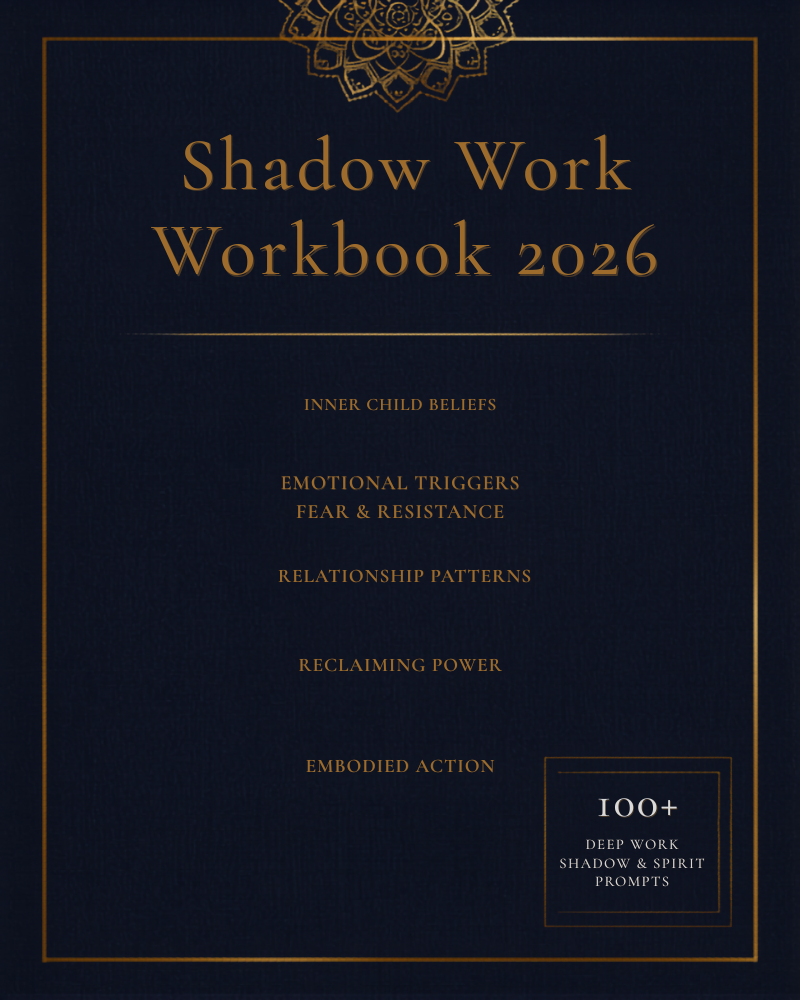
Loose prompts open the door; a structured practice walks you through it. Research on expressive writing shows the benefits compound when writing is consistent and progressive rather than occasional (American Psychological Association). That’s exactly why the Shadow Work Journal & Workbook is built as a guided, moon-aligned arc — 90 prompts structured around the new and full moon cycles, with inner-child reparenting woven throughout — rather than a random list. If you’re ready to move from dabbling to a true practice, begin there. Not sure shadow work is your starting point? Take the free 2-minute journal quiz and find the door that’s yours.
FAQ
Is shadow work dangerous? For most people it’s challenging but safe. If you have unprocessed severe trauma, work alongside a licensed therapist and go slowly.
How long until I notice change? Most people notice softer reactivity within 3–4 weeks of consistent practice. Deep integration is a season, not a weekend.
Can I do shadow work and manifestation together? They’re partners. Unexamined shadow is the most common reason manifestation stalls — you can’t call in what a hidden part of you believes you don’t deserve. Start with shadow; the Heal collection meets you after.
Begin your practice: Shadow Work Journal & Workbook →
External sources referenced: The SAP — Jung’s Shadow · APA — Expressive writing research
How to Use Shadow Work Prompts Without Spiralling
A list of shadow work prompts is easy to find and easy to misuse. The common failure is treating them as a quiz: answering fifteen in one sitting, feeling wrung out, and never opening the notebook again. The prompts are not the practice. The practice is one prompt, sat with long enough that the second and third answers arrive.
The first answer to any good prompt is nearly always the socially acceptable one, because that is the answer you have rehearsed. The useful material sits under it. A simple method: answer the prompt, then write “and what else is true?” and answer again, three times. The third pass is usually where something you did not already know shows up.
Working With Resistance Instead of Around It
If a prompt makes you want to close the notebook, you have found the right prompt. That is not a reason to push harder; it is a reason to slow down and write about the resistance itself rather than the topic. What exactly do you not want to look at, and what do you imagine would happen if you did?
Resistance handled this way tends to dissolve within a few minutes of honest writing. Resistance overridden by force tends to produce a shutdown that lasts weeks.
The Four Families of Shadow Prompts
Projection prompts
These work with what you find intolerable in other people, on the principle that strong reactions point at disowned material. Who irritates you disproportionately, and what specific quality is it? What would it cost you to admit you have that quality too, in smaller measure?
Envy prompts
Envy is a reliable pointer at a desire you have refused yourself permission to hold. Whose life produces a pang, and what specifically about it? What have you decided about people who want that openly?
Rule prompts
Every family issues rules that were never stated. What was never allowed to be said in your house? What did you learn was the acceptable emotion, and which one was forbidden? Which rule are you still obeying without having agreed to it?
Compensation prompts
These examine what you over-do, on the principle that most compulsive behaviour is protecting against a specific fear. What do you do too much of, and what would you have to feel if you stopped for a week?
A Ninety-Minute Month
Three twenty-minute sessions a week for a month is more than enough to make real progress, and it is small enough that you will actually do it. Structure the month rather than picking prompts at random.
- Week one: projection. One person per session. Specific qualities only.
- Week two: envy. One pang per session, followed by what you have decided about people who want that thing.
- Week three: rules. One unspoken family rule per session, and where you still obey it.
- Week four: integration. Read the three weeks back. Write the two or three sentences that keep recurring in different clothing. Those are your actual material.
What Integration Looks Like in Practice
Integration is not a feeling of peace about the material. It is a widened set of available responses. Before integration, an intolerable quality in someone else produces contempt automatically. After, it produces recognition first, and then a choice. The contempt may still arrive. The difference is that it arrives as an option rather than as the whole of you.
You will know it is working when you catch yourself mid-reaction, when your apologies get more specific, and when a quality you once could not tolerate becomes something you can name in yourself without collapsing about it.
Safety and Limits
Shadow work goes towards difficult material by design, which makes the boundaries important. Keep sessions time-boxed. End with something ordinary and physical. Do not use these prompts to excavate active trauma alone. If what surfaces is overwhelming, intrusive, or affects your ability to function, that is the point to work with a licensed professional rather than a longer list of prompts.
Frequently Asked Questions About Shadow Work Journal Prompts
How many prompts should I do in one sitting?
One. Depth comes from staying with a single question, not from covering ground. A fifteen-prompt session almost always produces fifteen surface answers.
What if nothing comes up?
Write “nothing is coming up” and keep the pen moving for the remaining minutes. Blankness is usually a protective response rather than an absence, and it tends to break within a few lines of writing about the blankness itself.
Should I reread what I write?
Not immediately. Weekly review is where the patterns appear; same-day rereading tends to turn into editing and self-criticism.
Is shadow work safe to do alone?
For ordinary material, with time limits and a way to land afterwards, generally yes. For trauma, grief in its acute stage, or anything involving harm, it belongs alongside professional support rather than instead of it.
Begin Tonight
Choose one projection prompt, set a timer for twenty minutes, and use the “and what else is true?” method three times. Then close the notebook and do something ordinary with your hands.
If you would rather not choose the prompts yourself, the shadow work journals below sequence ninety days of them, each one different from the last, with the teaching on the page before the question. As always, this is a tool for integration and not a replacement for professional support.
Prompts for the Parts You Like About Yourself
Shadow work has a reputation for being exclusively about the unwelcome material, and that is only half the concept. The golden shadow is the term for qualities you disowned because having them was unsafe or immodest rather than because they were bad: ambition, authority, talent, desire, the wish to be looked at.
These are frequently harder to reclaim than the difficult ones, because the rule against them was usually enforced socially rather than harshly. Nobody punished you for being capable. They simply made it clear that saying so out loud was distasteful, and you adjusted.
Golden shadow prompts
- Who do you admire in a way that feels slightly out of reach, and what specific quality is it?
- What compliment do you deflect every single time? What would it cost to accept it?
- What were you good at as a child that you stopped doing? Who was in the room when you stopped?
- What do you want that you would be embarrassed to say plainly? Say it plainly on the page.
- Where are you playing small in a way that reads as humility and functions as hiding?
Work these with the same “and what else is true?” method. The third pass is where the honest answer lives, and with golden shadow material the honest answer is frequently a straightforward statement of want that you have never written down before.
Keeping a Pattern Index
After a month or two of prompt work the entries start repeating, and this is the point at which the practice becomes genuinely useful rather than merely interesting. Give yourself a page at the back of the notebook and keep a running index of the beliefs you keep finding.
- One line per belief, in the plainest words available.
- A tally mark each time it reappears. The counting does something that description does not.
- The date you first named it. Watching how long a belief has been running is often what finally loosens it.
- One line on where it was learned, once you know.
- One line on the evidence against it, added whenever you find some. This is the column that eventually does the work.
Most people end up with four or five entries on that page and are surprised by how few there are. A life’s worth of difficult reactions usually traces back to a handful of conclusions, and seeing them listed on a single sheet is the most compressed and useful thing shadow work produces.
Where the Prompts Should Take You
A last orientation. The purpose of prompt work is not to produce a complete account of your own psychology. It is to widen the number of responses available to you in an ordinary moment.
If after two months you have four beliefs listed at the back of the notebook and a slightly longer pause before you react, the practice has done exactly what it is for. That is a smaller claim than most writing on this subject makes, and it is the one that holds up.