Buck Moon Ritual (July 29, 2026): Strength, Antlers, and the Aquarius Call to Outgrow
Table of Contents
The short version: a buck moon ritual asks what has to come off before anything new can grow. Below you will find the swap list, how to protect something unfinished, and a midsummer review. The point of a buck moon ritual is the arithmetic of what you are giving up, not the ceremony.
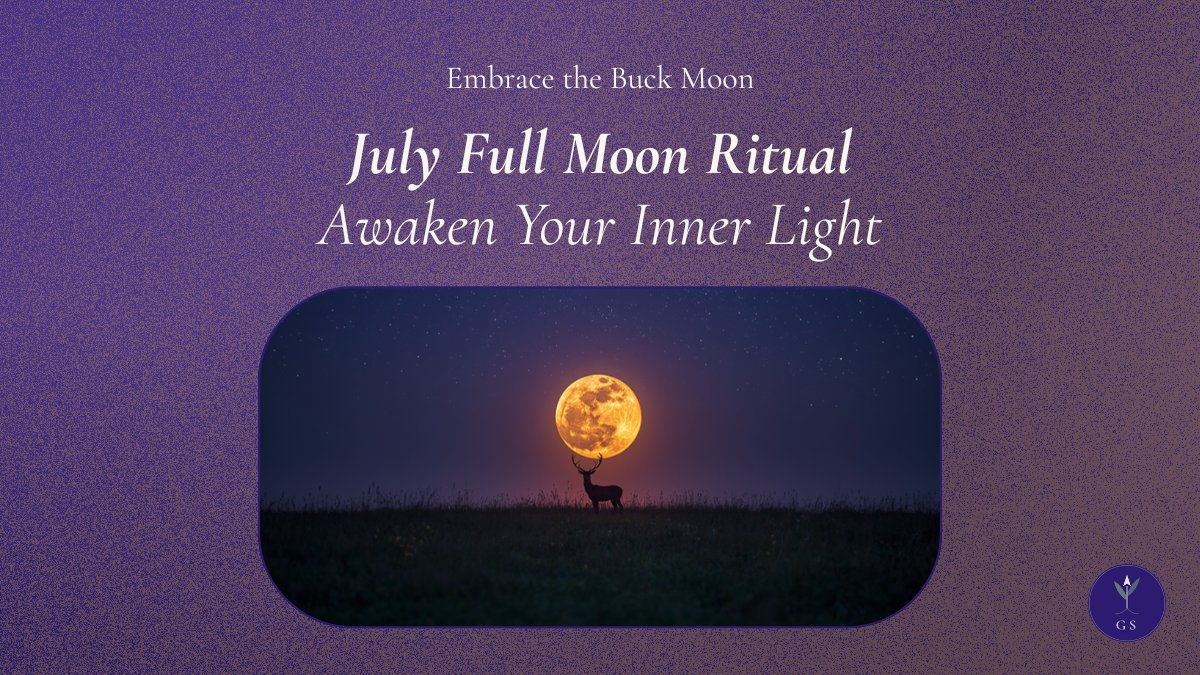
July’s full moon — the Buck Moon — peaks on Wednesday, July 29, 2026, at 10:36 a.m. Eastern, which means the nights of July 28 and 29 are your ritual window, with the moon rising golden in the southeast after sunset (Almanac.com). The name comes from the season’s most visible miracle: midsummer is when bucks’ antlers are in full growth — up to an inch a day, among the fastest-growing tissue in the animal kingdom. Hold that image, because it’s the whole teaching of this moon: antlers are grown to be shed. Every year the buck builds his crown, carries it, and lets it fall — and grows greater the next season. The Buck Moon asks what you’ve grown this year… and what you’ll have the courage to shed when its season ends.This Year’s Flavor: Full Moon in Aquarius
Astrologically, the July 2026 full moon lands in Aquarius — the sign of the future, the community, and the liberated self (Farmers’ Almanac). Aquarius full moons illuminate the tension between belonging and authenticity: where are you shrinking to fit a group, a role, a version of yourself that the people around you find comfortable? With the sun in heart-centered Leo opposite this moon, the question sharpens: can you be fully yourself AND fully belong? That’s the axis this ritual works.
The Buck Moon Ritual (4 Movements, ~30 Minutes)
1. Stand in your strength (5 minutes)
Outside if you can, under the rising moon. Stand tall — actually tall, spine long, crown lifted. Breathe slowly and recall, one by one, three difficulties you’ve carried this year and are still standing through. This isn’t vanity; it’s accuracy. The Buck Moon is first a moon of acknowledging grown strength.2. Name the antlers (10 minutes)
In your journal, write what you’ve grown since winter: skills, boundaries, healings, courage, work in the world. Write quickly and generously — midsummer is not the season for false modesty. Then circle the one you’re proudest of and write three sentences about what it cost you to grow it.3. Choose the shedding (10 minutes)
Now the Aquarius work. Complete these lines:- “I have outgrown ______.”
- “I keep carrying ______ because the people around me expect it.”
- “If I trusted I’d still belong, I would release ______.”
4. Seal with the future self (5 minutes)
Aquarius rules the future. Close by writing five lines from the you of next summer — the one who shed it: “From here I can tell you…” Let her describe what life is like on the other side. Blow out the candle. Done.
10 Buck Moon Journal Prompts
- What have I grown this year that I haven’t paused to honor?
- What strength do I now carry that last July’s me didn’t?
- What am I still wearing — role, habit, identity — that fit a former season?
- Where do I dim my full self to keep a group comfortable?
- What would I do differently if belonging were guaranteed?
- What is my community — and does it water me or just harvest me?
- What future is trying to get my attention this summer?
- What’s the bravest thing I could shed before autumn?
- Who in my life celebrates my antlers — and have I told them?
- What does the strongest version of me know that I keep forgetting?
Ride the Whole Cycle
This full moon completes what the Cancer new moon on July 14 planted — if you set intentions then, tonight is when you check what rose toward the light. That rhythm — plant, tend, harvest, shed, rest — is the oldest self-development system there is, and working it month after month is where its real power lives. The Mother Moon Journal holds the full practice cycle after cycle, and the Full Moon Ritual Guide — coming soon to the Root collection — gives every full moon of the year its own ritual, correspondences, and prompts. Join the notify list there for launch access. New to all of this? The free New Moon Ritual Guide is the gentlest place to start. Next on the calendar: the Leo solar eclipse new moon on August 12 — one of the most potent intention-setting moments of 2026. We’ll cover it next.
FAQ
When exactly should I do the Buck Moon ritual? Peak is 10:36 a.m. ET July 29, so the nights of July 28 and 29 are equally potent; July 27–31 all sit within the window. What’s the difference between new moon and full moon rituals? New moons are for planting (intentions, beginnings); full moons are for harvesting and releasing (gratitude, completion, shedding). Different halves of one breath. Do I need anything special? A journal, a pen, a candle, and the sky. Sincerity is the only required tool.Make every moon a practice: Mother Moon Journal → · External sources referenced: Almanac.com — July Buck Moon · Farmers’ Almanac — July full moon astrology
The Buck Moon Is About What Growth Costs
The Buck Moon takes its name from the season when a stag’s new antlers are in velvet, growing fast and vulnerable. What makes that image useful for a ritual practice is the part people skip: antlers only regrow because they were shed. The animal drops a structure that took a full season to build, walks around without it, and then grows a larger one.
That is the question this moon puts to you. Not what do you want to grow. What are you still carrying that has to come off first, and are you willing to spend a season looking unfinished?
The Cost Nobody Budgets For
Most people plan growth as addition. New habit, new skill, new project, layered on top of a schedule that is already full. It fails for the obvious reason, and the failure gets interpreted as a discipline problem rather than an arithmetic one.
Real growth is nearly always a swap. The hour has to come from somewhere, and the honest work of midsummer is naming where. If you cannot name what you are giving up, you have not committed to the thing you say you want.
A Buck Moon Practice: The Swap List
- Write what you are growing. One thing, specifically, in behaviour terms.
- Cost it in hours. Actual hours per week, honestly estimated and then increased by half, because everything takes longer than the plan.
- Find those hours in your current week. Not in theory. Open the calendar and point at them.
- Name what leaves. Whatever occupied those hours is what you are shedding. Write it down as a loss, not as a thing you were going to stop anyway.
- Sit with the discomfort of the vulnerable stage. The period between shedding and regrowth is when most people quietly pick the old thing back up. Expect it, name it in advance, and decide now what you will do when it arrives.
Growing in Velvet: Protecting Something Unfinished
New growth is soft. A practice three weeks old cannot survive being shown to a sceptical audience, and neither can a half-formed idea. The mistake is announcing it, gathering opinions, and losing the thing before it hardened.
- Tell one person, not five, and choose someone whose default is curiosity rather than assessment.
- Do not seek feedback on the direction until you have a month of evidence.
- Protect the time before you protect the output. The output cannot exist without the time.
- Track effort, not results, for the first cycle. Results arrive on their own schedule and will not cooperate with your morale.
Midsummer Review: Half the Year Is Gone
July is the honest midpoint. Whatever you intended in January has had six months, and reviewing it here gives you a full second half to respond, which a December review cannot.
- What did you actually spend the first half of the year on? Not what you intended. Where the hours went.
- Which of January’s intentions still matter to you, in your own body, when you read them back?
- Which have quietly become obligations you are carrying out of pride?
- What would you drop today if nobody would notice?
- What one change to the second half would you thank yourself for in December?
Frequently Asked Questions About the Buck Moon Ritual
Is the Buck Moon a good time to start something?
It is a good time to shed something so that a start becomes possible. The starting itself sits more naturally at the new moon a fortnight later, once the space has actually been cleared.
What if I cannot find anything to give up?
Then either the new thing is smaller than you think, or the honest answer is sleep, and that is not a trade worth making. A week of tracking where your hours actually go usually resolves this within a day or two of data.
Do I need a ceremony for this?
No. Twenty minutes, paper, and a willingness to write the real number of hours is the whole practice. Ceremony is optional and does not substitute for the arithmetic.
This Week
Write the swap list tonight, and then actually open your calendar and delete the thing you named. The deletion is the ritual. Everything else is preparation for it.
If you want the year already broken into cycles with a midpoint review built in, the lunar journals below carry dated pages through every phase, so the July review is waiting for you rather than something you have to remember to invent.
Tracking a Full Lunar Year
One moon ritual is an evening. Twelve tracked cycles is a body of evidence about how you actually work, and it is the difference between reading about lunar practice and having your own. The tracking does not need to be elaborate. One line a day for a year is enough to produce findings that no general guide could give you.
What to record
- Date and phase. New, waxing, full, waning. Four categories is plenty.
- Energy, one to five. A number, not a description. Numbers can be graphed; adjectives cannot.
- Sleep, in hours. The single most confounding variable, and the one people leave out most often.
- One word for mood. Chosen quickly, before you think about it.
- Anything unusual. Illness, travel, conflict, a deadline. Context is what stops you drawing a lunar conclusion from a work crisis.
What you are looking for
After three cycles, look for repeats at the same point in the cycle. Three is the minimum before anything means anything, and even then it is a hint rather than a finding. After six, the pattern is worth acting on. After twelve, you have something genuinely reliable, including the honest possibility that your energy does not track the moon at all — which is itself worth knowing and will save you years of adjusting your life to a rhythm that is not yours.
Working With the Waning Weeks
The two weeks between the full moon and the next new moon get almost no attention in popular lunar practice, which is a pity, because for many people they are the most useful stretch of the cycle. Nothing is being launched and nothing is culminating, which leaves them free for the maintenance work that never gets scheduled.
- Finish something. Not start. The waning half is where partly-done things are best completed.
- Close loops. The email you have not answered, the appointment you have not booked, the thing you said you would do in June.
- Reduce rather than add. Cancel one thing. Remove one input. Say no to one request.
- Rest deliberately in the last three days before the new moon, and treat that as part of the practice rather than as time off from it.
Structured this way, the month has a shape: begin at the new moon, build through the waxing weeks, assess at the full moon, complete and clear through the waning weeks. That shape is doing most of the work, whatever you believe about the moon itself.
When You Cannot Shed What Needs to Go
The swap list assumes the hours are available if you are honest enough to find them. Sometimes they genuinely are not. Caring responsibilities, a job with fixed demands, health, a period where survival is the whole agenda — in those seasons the swap arithmetic returns nothing, and pushing anyway produces only guilt.
What the practice offers then is different and still worth having: the honest naming of a season where growth is not the assignment. Written down explicitly — “this is not a season for building, it is a season for holding” — it stops the low-grade self-criticism that comes from measuring a maintenance season against a growth season’s standards.
What to do with the want in the meantime
- Write it down and date it. An articulated want that is not being acted on is not lost. An unarticulated one usually is.
- Reduce it to its smallest honest version. Not the project, the ten-minute-a-week version of the project. Ten minutes a week keeps a thread alive across a year.
- Name the condition that would change things. A child starting school, a treatment finishing, a contract ending. Knowing what you are waiting for is materially different from waiting indefinitely.
- Revisit at the next full moon, not sooner. Checking a locked situation weekly only reconfirms that it is locked.
Reading the Year So Far at Midsummer
July is the honest midpoint of the calendar year, and reviewing here rather than in December is the single most useful timing adjustment available, because you still have five months to respond to what you find.
Read January’s intentions if you wrote any. If you did not, reconstruct them in five lines. Then answer three questions in writing: what did the first half of the year actually consist of, which of those things did you choose, and what would you like the second half to be about?
That third question is the one worth sitting with. Most people answer it faster than they expect, and the answer is usually already known and has simply never been said out loud. Write it, then name the single thing you would have to shed to make room for it, and put a date on the shedding before you close the notebook.
A Closing Note on Antlers
It is worth finishing on the part of the image that is easy to miss. The stag does not shed in order to be smaller. It sheds because the new growth cannot happen with the old structure still attached, and for a period it walks around visibly unfinished.
That interval — carrying nothing, in full view — is the whole difficulty of this season, and it is not a gap between two useful states. It is the mechanism. Nothing regrows without it.
Buck Moon Ritual: The Swap
A buck moon ritual is complete when you have named what you are growing, costed it in hours, found those hours in your actual week, and deleted whatever occupied them. The deletion is the buck moon ritual. Everything before it is preparation.