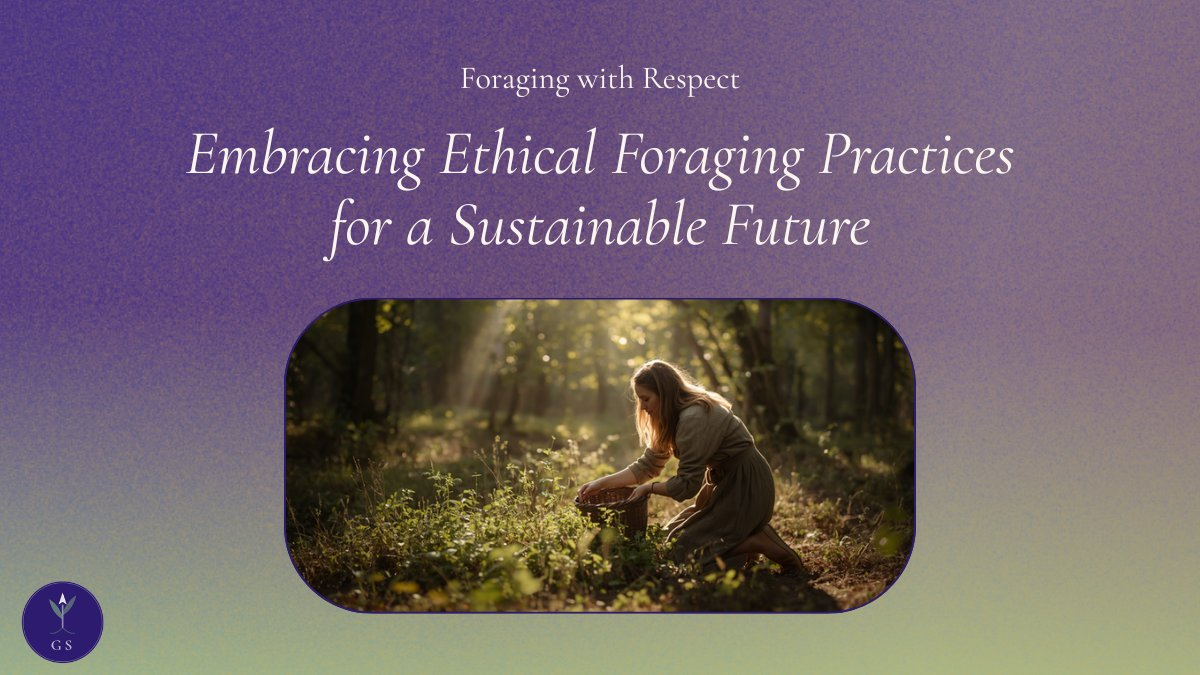
Sustainable Foraging: The Wildcrafting Ethics That Keep Wild Places Alive
Table of Contents
The short version: sustainable foraging is a population question rather than a basket question. Below you will find why slow-growing species need different rules, the restoration habit, and when sustainable foraging means buying rather than gathering. Genuine sustainable foraging is a practice you adjust each year from your own site records.
Sustainable foraging — often called wildcrafting when the harvest is medicinal — means gathering wild plants in a way that leaves the plant population, the habitat, and the relationship healthier than you found them. As foraging surges in popularity, this is no longer a niche concern: beloved patches get stripped, slow-growing medicinals vanish, and the question every forager must answer moves from “can I eat this?” to “should I take this?”
The good news: the ethics aren’t complicated. They’re old. Indigenous harvesting traditions, modern conservation science, and plain neighborliness all converge on the same handful of principles. Here is the code — and the practice that holds you to it.
The Honorable Harvest
Potawatomi botanist Robin Wall Kimmerer describes the “Honorable Harvest” in Braiding Sweetgrass — a covenant of reciprocity that has guided Indigenous gathering for millennia: never take the first plant you find. Ask permission, and listen for the answer. Take only what you need. Use everything you take. Give something back (hear Kimmerer on the Honorable Harvest).
This isn’t decoration on top of foraging technique. It is the technique, practiced for thousands of years by people whose lives depended on the patch still being there next season.
The 7 Rules of Sustainable Foraging
1. Identify at 100% — including the plant’s status
Beyond safety, know whether the species is abundant or at risk. United Plant Savers maintains the essential “Species At-Risk” list — slow-growing natives like American ginseng, goldenseal, and ramps are routinely over-harvested. If it’s on the list, grow it, don’t gather it.
2. The one-third rule — at most
Never harvest more than a third of any patch — and for roots or whole plants (where harvest kills), take far less, or nothing. Leaves and flowers regrow; a dug root is a subtraction forever.
3. Never take the first one
The first plant might be the only one. Walk on. If the patch is plentiful, the first one you found will still be there on your way back — and you’ll have answered the abundance question honestly.
4. Harvest where plants thrive, not where they struggle
A vigorous roadside-free meadow colony can spare some yarrow; three stressed plants at the edge of their range cannot. Take from abundance only.
5. Disturb little, and give back
Step lightly, refill holes, scatter ripe seeds as you go, pull invasives where you recognize them. Reciprocity can be very practical.
6. Know the law of the land
Your land: harvest freely. National forests: typically personal-use gathering allowed (check the ranger district). State/city parks and nature preserves: usually prohibited. Private land: permission, always. The USDA Forest Service has gathering guidelines by forest.
7. Take only what you’ll actually use
The compost pile full of last summer’s wilted intentions is the most common foraging sin. Harvest for the recipe you’ll make this week, not the apothecary you imagine someday owning.
The Forager’s Journal: Where Ethics Become Practice
Here’s the truth about every rule above: they all depend on memory and attention — exactly the two things a journal is for. Sustainable foragers are record-keepers, because you cannot practice reciprocity with a patch you can’t remember. A wildcrafting journal tracks:
- Patch records: location, species, size, health — year over year. (Is the colony growing or shrinking since you began visiting? That answer is your report card.)
- Harvest logs: what you took, how much, what you left — your one-third rule, enforced by your own handwriting.
- Phenology notes: what bloomed when, this year vs. last. You become a literal citizen scientist of your home ground.
- Give-back log: seeds scattered, invasives pulled, thanks given.
New to foraging entirely? Start with our beginner’s guide to herbal foraging and its 12 summer plants — then let the journal grow with you.

Foraging as Sacred Relationship
Strip away the technique and what remains is this: foraging done well is a relationship — attention, restraint, gratitude, return. You kneel, you ask, you take a little, you say thank you, you come back next year to see how the patch is doing. In a culture that mostly teaches taking, that’s not a small practice. It’s a quiet revolution conducted in meadows, one honorable handful at a time.
FAQ
Is foraging bad for the environment? Done carelessly at scale, yes. Done by the code above, foragers historically tend their patches — many thrive under attentive, reciprocal harvesting.
What plants should beginners never harvest? Anything on the United Plant Savers at-risk list — ginseng, goldenseal, ramps (in most regions), lady’s slipper, and slow-growing roots generally.
Can I sell what I forage? Commercial harvest is a different ethical and legal world — permits, quotas, and far stricter sustainability math. Master personal-use practice for several seasons first.
Keep the record your patches deserve: org/species-at-risk-list/”>United Plant Savers — Species At-Risk · USDA Forest Service — gathering guidelines · Forage with intention.
Keep a simple record of every find, and grab a free guided practice from our Free Resources library.
Sustainable Foraging Is a Population Question
Most wildcrafting ethics is written at the scale of the individual basket, and that is the wrong scale. A single careful harvest is almost never the thing that damages a plant community. What damages it is a hundred careful harvesters visiting the same accessible stand in the same six-week window, each one taking a responsible third of what they can see.
Once you think at population scale, the decisions change. The question stops being how much can I take and becomes how much can this stand give to everyone who will visit it this year. In a well-known spot near a car park, the honest answer is often none.
The accessibility problem
Pressure on wild plants is not evenly distributed. It concentrates within a few hundred metres of parking, paths and viewpoints. This means the stands you find easily are the stands under most pressure, and the ones you find after twenty minutes of awkward walking are usually fine. If you are going to harvest, earn it with distance.
Slow-Growing Species Deserve Different Rules
A fast-growing annual that sets thousands of seeds recovers from harvest in a season. A slow perennial that takes seven years to reach maturity does not. Applying the same guidance to both is how well-meaning foragers strip a species out of a valley over a decade.
- Roots and bark are the highest-impact harvest, because taking them usually kills the individual. Treat any root harvest as a serious decision requiring an abundant, verified population.
- Leaves and aerial parts are the lowest impact, particularly taken before flowering, provided you leave enough for the plant to keep photosynthesising.
- Seed is deceptive. Taking seed feels gentle and removes next year’s generation. In a small stand it is more damaging than taking leaf.
- Fungi are their own subject. The visible part is fruiting body rather than organism, but repeated trampling of the ground around it is a genuine harm and the identification stakes are higher than with plants.
The Restoration Habit
The foragers who have the least impact all share one behaviour: they put something back, deliberately, every time they take. Not symbolically. Practically.
- Scatter seed from the stand you harvested, in the same area, at the right season.
- Clear a competing invasive from the patch while you are there.
- Fill and firm any ground you disturbed, particularly around roots.
- Record the stand’s size and health so you can tell in three years whether it is declining.
- Tell nobody the precise location of anything rare. Specific locations shared publicly are the fastest route to a stripped site.
Permission, Law and Land
Ethics and legality are not the same thing, and you need both. Rules on gathering differ by country, by land designation and by species, and they change. Protected species exist in most jurisdictions, protected sites almost always carry additional restrictions, and commercial harvesting is usually governed separately from personal use.
Check your local regulations before you gather, and where land is privately held, ask. A landowner who has been asked once will often say yes for years. A landowner who finds strangers with baskets will close the gate permanently, for you and for everyone after you.
Learning From Traditional Harvesting Principles
Many long-standing harvesting traditions encode population-scale thinking in practical rules: never take the first plant you find, never take the largest, take only what you will use, and return to the same ground across generations so that decline is visible within a single family’s memory.
These principles work because they build in restraint at the moment of decision rather than relying on calculation afterwards. Whatever your background, adopting the mechanics is sound practice: the first stand you find tells you the plant is present, not that you should harvest it.
Tools and Technique That Reduce Damage
- A sharp knife or snips, not fingers. Tearing damages the growing point and invites disease.
- Cut above a node so the plant can regrow rather than sitting as a dead stem.
- A basket rather than a bag, so seed falls back onto the ground as you walk.
- Stay on one route in and out. Trampling is usually the larger impact and nobody counts it.
- Harvest in dry conditions where you can, to reduce spreading disease between plants on damp tools and boots.
Frequently Asked Questions About Sustainable Wildcrafting
Is the one-in-twenty rule better than take a third?
For slow-growing perennials and anything locally uncommon, yes, and for roots the honest number is often zero. The proportion should follow the species and the site, not a single memorised figure applied everywhere.
How do I know if a plant is common in my area?
Local botanical societies, county recorders and national biodiversity records are the reliable sources. Personal impression is a poor guide, because a plant that is abundant on your walk may be in regional decline.
Is buying dried herbs more ethical than foraging?
Sometimes, and it depends entirely on the supply chain. Cultivated material from a known grower usually has lower wild impact than harvesting a slow perennial. Wild-collected commercial material can have far higher impact than anything you would do personally.
What should I do if I find a stand that has been over-harvested?
Leave it entirely, record it, and return the following year to see whether it recovered. That record is genuinely valuable data, and it is the kind that only regular local walkers ever collect.
Where to Begin
Before your next harvest, write down the stand size, the species, the date and what you took. Do it for a year. The habit of recording is what converts good intentions into an actual practice, because it makes decline visible while there is still time to stop.
The foraging and nature journals below give you dated pages for exactly this: stand size, habitat, what you left, and a place for the sketch that teaches you the plant properly.
Keeping a Site Record Over Years
The most valuable thing a forager can produce is not a harvest. It is a multi-year record of specific sites, because decline is invisible in any single season and obvious across five. Most people who have watched a patch disappear only realised it afterwards, and by then the question of whether their own harvesting contributed is unanswerable.
- Give each site a name and a fixed description. Not a photograph alone. Written directions you could follow in winter.
- Record stand size the same way every year. Paces across, rough number of plants, or area. Consistency of method matters more than precision.
- Note who else is visiting. Cut stems, trampled ground, tyre tracks. Pressure from others changes what your own responsible share looks like.
- Record the surrounding change. New fencing, a felled tree, a change of grazing. Most declines are habitat change rather than harvesting.
- Photograph from the same spot each year. One image per site per season is enough, and the series is worth more than any single picture.
When to Stop Harvesting a Site Entirely
Deciding to stop is the hardest discipline in wildcrafting, because it is a decision to give something up on the basis of information that is never quite conclusive. A few triggers are clear enough to act on without further debate.
Stop if the stand is smaller than the previous year in the absence of an obvious habitat cause. Stop if you find yourself walking further into the stand than you used to in order to find good material. Stop if you see other people’s cuts on more than a few plants. And stop if you notice yourself constructing an argument for why this year is an exception — that reasoning is the most reliable warning sign there is.
Teaching Someone Else to Harvest
Wildcrafting knowledge spreads faster than the plants recover, which makes how you teach as consequential as how you harvest. A beginner shown a location learns a location. A beginner shown a method learns to find their own, and the difference over a decade is substantial.
- Teach identification before use. Someone who can name a plant confidently and knows nothing about harvesting it is safe. The reverse is not.
- Teach the look-alikes first. Every session should include what this is not, and why it matters.
- Teach restraint as a skill, not a rule. Walk past a stand together and say out loud why you are not harvesting it. Modelled restraint transmits; stated restraint does not.
- Do not hand over locations for anything uncommon. Teach habitat reading instead, so they can find their own and the pressure stays distributed.
- Say plainly that you are still learning. Certainty is the most dangerous thing you can pass on in this practice.
This is also the strongest argument for keeping site records. Handing a beginner a method and a habit of note-keeping gives them something that keeps working after you are not there to ask, and it makes them a contributor to local knowledge rather than another pair of hands on a shrinking patch.
The Case for Buying Some of It
Sustainability sometimes points away from harvesting altogether. For slow-growing perennials, anything locally uncommon, and any root you would otherwise take, cultivated material from a known grower usually has a far lower wild impact than your own careful gathering.
This is an uncomfortable conclusion in a practice that values self-sufficiency, and it is the honest one. Wild populations near population centres are under pressure that no individual restraint fully offsets, whereas a grower producing the same plant in a field is not drawing on a wild stand at all.
A workable position: forage the abundant and the fast-growing, buy the slow and the scarce, and keep your records either way so you know which category anything actually falls into where you live.
A Practice, Not a Position
Sustainable wildcrafting is often argued as a position — one third, never roots, only abundant species. Positions are easy to hold and easy to apply badly, because the right answer genuinely differs between two stands a mile apart.
What survives contact with real ground is a practice: look first, record what you find, decide in front of the plant rather than in advance, and let this year’s notes change next year’s decision. That is slower than a rule and it is the only approach that responds to what is actually happening where you walk.
Sustainable Foraging: The Practice in One Line
Sustainable foraging means deciding in front of the plant rather than in advance, recording what you find, and letting this year’s notes change next year’s harvest. Anyone offering sustainable foraging as a single fixed rule has not stood in front of two very different stands a mile apart.