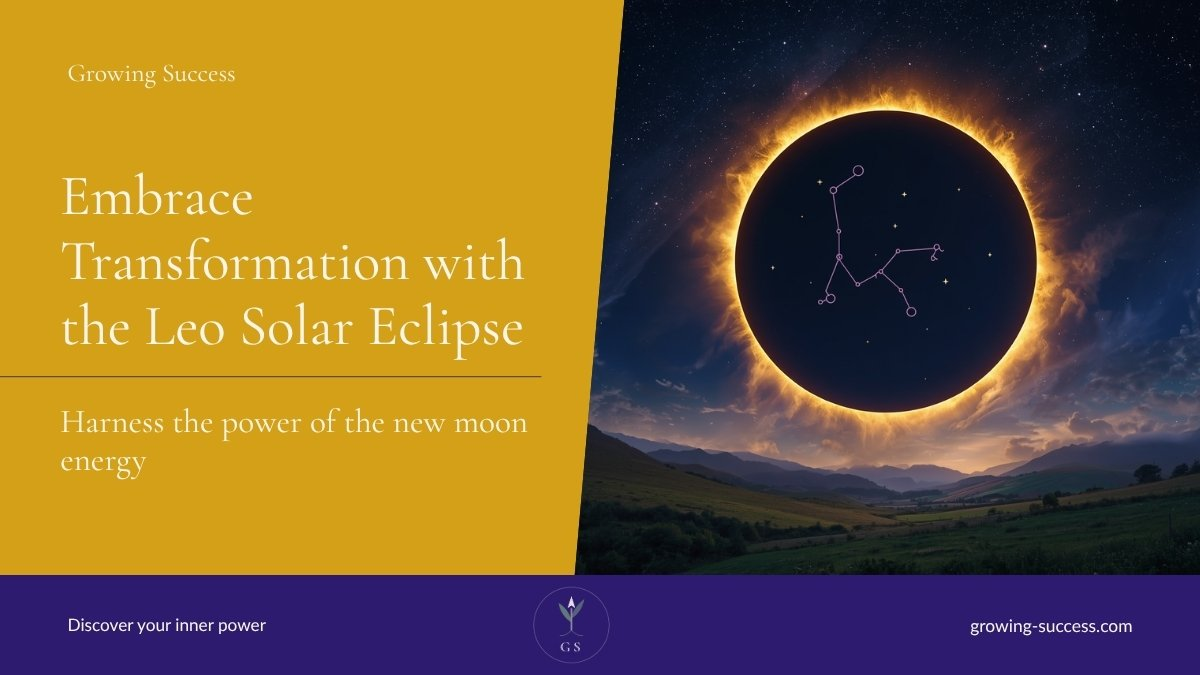
The Leo Solar Eclipse New Moon (August 12, 2026): A Once-a-Season Reset for Your Becoming
On Wednesday, August 12, 2026, the new moon arrives as a total solar eclipse in Leo (CHANI’s 2026 key dates) — and remarkably, this one will be visible as a deep partial eclipse across much of North America and totality across parts of Greenland, Iceland, and Spain (NASA’s eclipse page has viewing details and safety guidance — never look at a partial eclipse without certified eclipse glasses).
In lunar practice, an eclipse new moon is the strong espresso version of intention setting. A regular new moon opens a monthly cycle; eclipses arrive in pairs along an axis that returns for about eighteen months, opening chapters that unfold across seasons. Astrologers traditionally read solar eclipses as accelerated beginnings — doors that open suddenly, sometimes before you feel ready. This one opens in Leo: the sign of the heart, creative fire, visibility, and the courage to be fully seen.
What Leo Solar Eclipse Energy Asks
Leo rules the part of you that wants to shine — not for the algorithm, but the original kind: making things, being wholehearted, taking up your space. A Leo eclipse tends to press on three questions:
- Where have you been hiding your light — waiting for permission, polishing instead of publishing, shrinking so no one calls you “too much”?
- What creative work is asking to be born — the book, business, art, or identity you keep deferring to a “someday” that the eclipse suggests is now?
- Where do you perform instead of express? Leo’s shadow is approval-seeking. The eclipse spotlights the difference between being seen and being validated.
How to Work With an Eclipse (It’s Different)
Traditional lunar practice actually advises against heavy ritual at the exact eclipse moment — eclipse energy is considered wild, fast, and not yours to steer. The wiser practice:
1. Before (Aug 10–11): Clear the stage
Eclipses sweep. Make the sweeping conscious: declutter one corner, complete one nagging task, write one page on “What am I willing to have ended, if something truer wants the space?” Hold plans loosely this week.
2. The day (Aug 12): Witness, don’t grip
Watch the eclipse if you’re in its path (with proper glasses). Rather than a full intention ceremony, write a single line in your journal — one sentence naming the becoming you’re available for: “I am available to be seen as ______.” Then close the book. Eclipse seeds plant themselves.
3. After (Aug 13–15): Set intentions in the settled air
Now do your full new moon practice — the same four-movement ritual from our new moon intention setting guide, aimed at Leo themes: visibility, creation, wholeheartedness. Write 1–3 intentions plus one aligned action each. Because this is an eclipse cycle, check back on these intentions not just at the full moon but in six months — eclipse chapters are long arcs.
10 Leo Solar Eclipse Journal Prompts
- What did eight-year-old me make, perform, or play at before anyone graded it?
- Where in my life am I waiting to be chosen instead of choosing myself?
- What would I create this year if applause and criticism were both impossible?
- Whose approval am I still performing for — and what has it cost?
- What is my heart’s actual answer to “what do you want?” (Not the reasonable answer.)
- Where am I “too much” — and who decided that?
- What ended (or is ending) this summer that I haven’t fully honored?
- What door would I walk through if it opened suddenly this month?
- What does generous, warm-hearted visibility look like for me — Leo at its best?
- One year from now, what do I want to have dared?
Eclipse Season Is a Journaling Season
Eclipse chapters reveal themselves in hindsight — which is precisely why they belong in a journal you’ll still be keeping when the answers arrive. The Mother Moon Journal holds your practice cycle after cycle, so next February you can look back at what you wrote this week and watch the arc complete — that’s the part no horoscope can give you. The Full Moon Ritual Guide and the Leo Astrology Journal (one of twelve sign journals on the way) are both coming soon to the Clear collections — join the notify lists for launch access. And if you’re new to all of it, begin with the free New Moon Ritual Guide: the Sturgeon full moon on August 28 will be your first harvest check.
FAQ
Can I look at the solar eclipse?
Only through certified eclipse glasses or indirect projection — a partially eclipsed sun damages eyes without pain warning. See NASA’s safety guidance.
Why not set intentions at the exact eclipse?
Tradition holds that eclipse energy is too volatile to direct — you witness it, then set intentions in the days after. Whether you read that as astrology or psychology (big moments cloud judgment), the waiting practice serves.
What if nothing dramatic happens on August 12?
Eclipse chapters unfold over months, not afternoons. Write the one line, keep the journal, and re-read in February — that’s where eclipses prove themselves.
Keep the long record: Mother Moon Journal → · Free New Moon Ritual Guide →
External sources referenced: CHANI — 2026 key lunar dates ·
Table of Contents
The short version: the Leo solar eclipse is a review point rather than a verdict, and it is best journaled across six weeks rather than acted on in three days. Below you will find the Leo and Aquarius questions, a six-week structure, and how to locate the Leo solar eclipse in your own chart.
How to Work With an Eclipse Without Overreading It
Eclipse seasons generate more anxious content than any other point in the astrological year, and most of it is unhelpful in the same way: it tells you something enormous is coming and gives you nothing to do. A more useful frame is that eclipses are review points, not verdicts. In astrological tradition they mark places where something that was already in motion becomes visible, which is a very different claim from the idea that the sky is about to do something to you.
The practical implication is that an eclipse is worth journaling around, not worth making decisions inside. Note what surfaces, and let the choices wait a fortnight. Almost nothing that genuinely matters needs to be settled in the seventy-two hours around an eclipse, and the pressure to settle it is usually the interesting part.
The Leo and Aquarius Axis, in Plain Terms
Eclipses always come in pairs across opposite signs, and the Leo and Aquarius axis is traditionally read as the tension between individual expression and collective belonging. Leo is the part of you that wants to be seen as yourself, specifically. Aquarius is the part that wants to belong to something larger and be judged by its usefulness to the whole.
You do not have to accept any astrological mechanism for this to be a productive pair of questions. Where in your life are you dimming yourself to remain acceptable to a group? And where are you performing individuality at the cost of connection you actually want? Most people are overweighted on one side, and know which within a few seconds of reading the question.
A Six-Week Eclipse Journal
Eclipse effects, in the traditional reading, are not confined to the day. A useful practice spans the fortnight before and the month after, which also happens to be long enough for genuine patterns rather than atmosphere.
- Two weeks before. One line a day: what feels unstable, unfinished, or newly obvious. Do not act on any of it.
- The three days around it. Write more, decide less. Note conversations that arrive unprompted and things you suddenly cannot ignore.
- The week after. Sort what surfaced into three lists: genuinely mine, someone else’s, and atmosphere.
- Weeks three and four. Choose one item from the genuinely-mine list and take a single concrete action on it. One. This is the entire payoff of the practice.
Where the Eclipse Falls in Your Own Chart
The general reading applies to everyone, which means it applies to no one very precisely. What sharpens it is knowing where roughly this degree of Leo sits in your own chart, because that is the area of life the review points at.
You need a birth chart with an accurate birth time to do this properly. Once you have it, find the house containing that degree and read the eclipse as a review of that department of life rather than of everything at once. This is the difference between a horoscope and astrology you can actually use.
What Not to Do During Eclipse Season
- Do not make irreversible decisions in a rush. The urgency is nearly always the thing worth examining rather than obeying.
- Do not read fifteen interpretations. Pick one source, read it once, and spend the remaining time on your own notes.
- Do not treat difficulty as fate. A hard week is a hard week, and attributing it to the sky removes exactly the agency you need to respond to it.
- Do not skip the after. Almost everyone journals the event and abandons the follow-up, which is where the value was.
Frequently Asked Questions About the Leo Solar Eclipse
Should I be worried about an eclipse?
No. Traditional astrology treats eclipses as significant markers, not as threats, and no reading of the sky removes your capacity to choose what you do next. If eclipse content is producing dread rather than reflection, that is a reason to read less of it.
How long do eclipse effects last?
Interpretations vary widely, from weeks to the eighteen months of a full eclipse series across an axis. For journaling purposes, six weeks is the useful window because it is long enough to show a pattern and short enough to sustain.
Do I need my exact birth time?
For house placement, yes, or the reading becomes general. Without it you can still work with the sign-level themes, which is where the Leo and Aquarius questions above are genuinely useful.
Is it a good time to start something new?
Traditionally this is treated as a period for endings, revelations and course corrections rather than initiations. The practical version: use it to see clearly, and start at the next new moon once you have.
Start With Two Questions
Tonight, answer both sides of the axis in writing. Where am I dimming myself to stay acceptable? Where am I performing individuality at the cost of something I want? Then leave the answers alone for a fortnight before deciding anything.
If you want the six-week structure already dated and laid out, the astrology year journals below walk every zodiac season and eclipse window with prompts written for your own placement rather than a general horoscope.
What to Do With What Surfaces
Eclipse periods have a reputation for bringing things to light, and the practical problem is rarely the surfacing. It is what people do next. The material arrives, the urgency arrives with it, and decisions get made in seventy-two hours that took years to become necessary and deserved more than a weekend.
- Write it, do not act on it. Everything that surfaces gets recorded and nothing gets decided for two weeks. Almost nothing genuinely cannot wait a fortnight.
- Separate the fact from the urgency. Write the fact in one sentence, then write the urgency in another, then look at them side by side. They are usually about different things.
- Notice what arrives unbidden. Conversations you did not initiate, messages from people you had not thought about, a realisation in the shower. Tradition treats these as the signal; practically, they are worth logging because they were not manufactured by you.
- Check it against last year. If you kept notes through the previous eclipse season, read them. Recurring material across two seasons is far more meaningful than anything from a single one.
The Eighteen-Month Arc
Eclipses across a given axis recur over roughly eighteen months, which means the Leo and Aquarius questions do not close at the end of one season. A single eclipse is a data point; the series is where the pattern lives.
The useful practice is therefore longer than most people run. Keep one page per eclipse across the whole series, in the same notebook, and read them consecutively at the end. Most people find one theme running through all of them wearing different circumstances each time, and that theme is the actual subject of the series.
Journaling the Eclipse in Your Own House
The general Leo and Aquarius themes apply to everyone, which is exactly why they can feel like they apply to no one in particular. The step that turns a horoscope into something testable is locating the eclipse degree in your own chart and reading it as a review of that specific area of life.
How to do it without learning astrology
- Get an accurate chart with your birth date, exact time and place. Time matters here; a few minutes moves house cusps.
- Find which house contains that degree of Leo. Any chart calculator labels the houses one to twelve.
- Read the plain-language meaning of that one house. Not all twelve. One paragraph, from one source.
- Write the question that house asks, in your own words, and journal that for six weeks instead of the general theme.
This is a twenty-minute exercise and it is the difference between “something is shifting” and “there is a specific question about how I structure my working days that keeps coming up.” Only one of those is useful in a notebook.
What Eclipse Content Gets Wrong
It is worth naming the pattern, because eclipse season generates a large volume of writing designed to be alarming and much of it is structurally unhelpful.
- Urgency without action. Something enormous is coming and there is nothing specific to do about it. This produces dread, which is not a useful state for reflection.
- Prohibitions with no reasoning. Do not sign, do not cut your hair, do not start anything. Traditional practice contains far more nuance than the list format allows, and blanket rules mostly transfer decision-making away from you.
- Retrofitting. Whatever happens gets attributed to the eclipse, including things with obvious ordinary causes. A journal that records predictions before the fact is the antidote, because it makes retrofitting visible.
- Treating everyone identically. The same eclipse lands very differently depending on chart placement, and general readings cannot account for that.
The Value of Recording the Misses
Keep a running verdict column and be strict with it. Hit, miss, unclear. Most people who do this for a year discover that a small number of transits are consistently meaningful in their own experience and the rest are atmosphere.
That finding is worth more than any amount of forecast reading, because it tells you where to spend your attention. It also protects the practice from becoming fatalistic: a record that can show a miss is a record you can trust when it shows a hit.
Leo Solar Eclipse: What to Actually Do
Write what the Leo solar eclipse surfaces and decide nothing for a fortnight. The urgency around an eclipse is usually the most interesting part of it, and a Leo solar eclipse handled that way tends to produce one clear action rather than a rushed decision.